
Pygmalion and Galatea
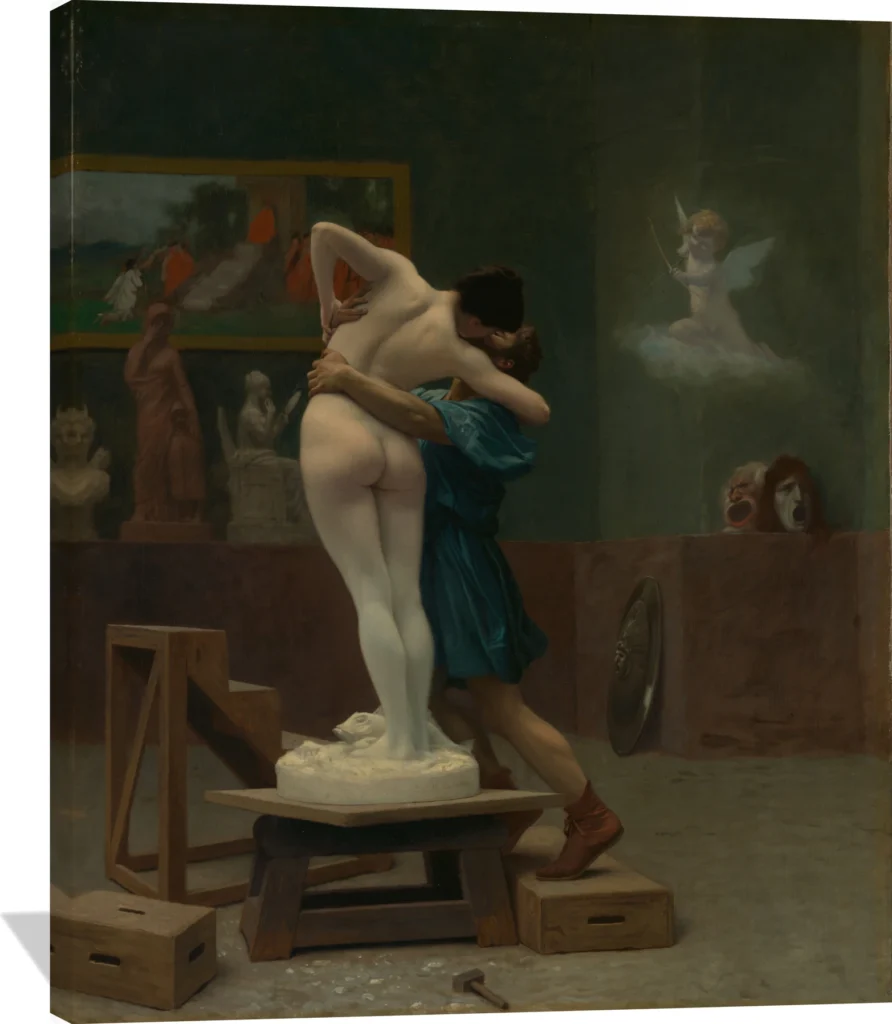
The Jean-Léon Gérôme Pygmalion and Galatea canvas captures the breathtaking moment when art transcends creation and becomes life. Bathed in soft golden light and rich emerald tones, this neoclassical masterpiece depicts the sculptor’s tender embrace with his living statue, blending realism and myth with exquisite precision. The balanced vertical composition and luminous skin tones evoke both intimacy and wonder.
Perfect as a statement piece for a living room, study, or entryway, this canvas print brings timeless romance and artistic mastery to any interior. Gérôme’s meticulous detail and emotional depth make Pygmalion and Galatea an unforgettable addition to refined wall art collections.
Jean-Léon Gérôme (French, Vesoul 1824–1904 Paris) was a master of Academic painting whose meticulously crafted works bridged classical traditions and emerging modern sensibilities. Renowned for his polished technique and precise draftsmanship, he became one of the most influential artists of the nineteenth century.
Artistic Style and Approach
Gérôme’s style is defined by exacting detail, clarity of form, and a disciplined finish that exemplifies the ideals of the French Academic tradition. His deep commitment to historical accuracy and visual storytelling allowed him to create images that feel both vivid and timeless. A leading advocate of the Academic realist ethos, he brought together archaeological research, dramatic composition, and a refined handling of light.
Signature Subjects
His oeuvre spans historical epics, mythological scenes, portraits, and the evocative Orientalist imagery for which he remains widely recognized. Gérôme often depicted ancient civilizations, gladiatorial arenas, and the splendor of the Near East, presenting each scene with cinematic precision. Works like The Snake Charmer and Pollice Verso exemplify his ability to transform historical moments into emotionally charged visual narratives.
Notable Contributions and Legacy
As a leading professor at the École des Beaux-Arts, Gérôme shaped generations of artists and helped define academic standards during a pivotal era in European art. His paintings and sculptures contributed to a broader cultural fascination with antiquity and the Middle East, influencing both artistic practice and public imagination. Revered for his technical mastery and historical vision, Gérôme’s legacy endures as a cornerstone of nineteenth-century Academic art.
Trust & policies
- 🚚 Free tracked shipping to 45+ countries. Local import duties or taxes may apply in some destinations.
- 🎨 Made-to-order, printed close to your delivery location
- 🛡️ If damaged, defective, or misprinted: free replacement or refund
- 🌍 Printed in US/CA/EU/UK/AU based on delivery location
- 💎 Acid-free, fade-resistant canvas with solid wood stretcher bars
- 🖼️ Optional pine floating frames in white, black, or brown
- 🪝 Ready to hang — hardware pre-installed