
The Dog Nobody Mentions: Four Hundred Years of Pets in Painting
The Metropolitan Museum’s catalogue entry for George Stubbs’s The Third Duke of Dorset’s Hunter with a Groom and a Dog discusses the horse, the groom, the oak tree, and the burdock leaves at the horse’s feet. It never mentions the dog.
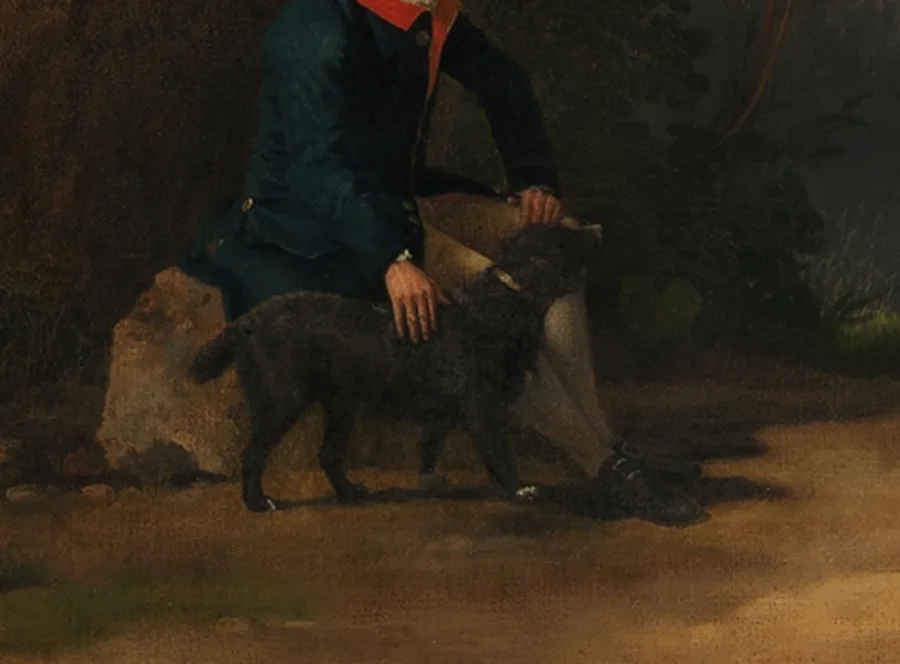
It has been sitting at the groom’s knee since 1768. You can stand in front of the picture, read the label, and walk away without ever having looked at it.
That is not a dig at the Met, whose decision to release its collection into the public domain is the only reason this page can show you anything. It is a habit of looking — ours, and art history’s — that turns out to be four centuries deep.
So we went looking. Twelve paintings, all in the Met, in order from 1550 to 1885. See how many animals you can find before we point them out.
Interactive
Find the animal
12 paintings, in order, from 1550 to 1885. In each one there is at least one animal. Tap where you think it is — then see what it was doing there.
Painting 1 of 12
of the canvas
See it at The Met →We measured the wrong thing first
The obvious story is that animals get bigger — background detail at first, growing until Rosa Bonheur can fill a canvas with nothing but a hound. So we measured it, drawing a box around the animal on the Met’s full-resolution image of each painting.
The story is wrong.
Titian’s hounds in 1550 take up more of the picture than Renoir’s dog does in 1878. The smallest animal of the twelve is not medieval at all — it is the black creature in Bingham’s canoe, painted in 1845, at eight-tenths of one per cent. Size goes up, down and up again, and explains nothing.
Which forces the better question. If they are not getting bigger, what is changing?
Look at what the animal is doing
Ignore scale entirely and look only at posture.
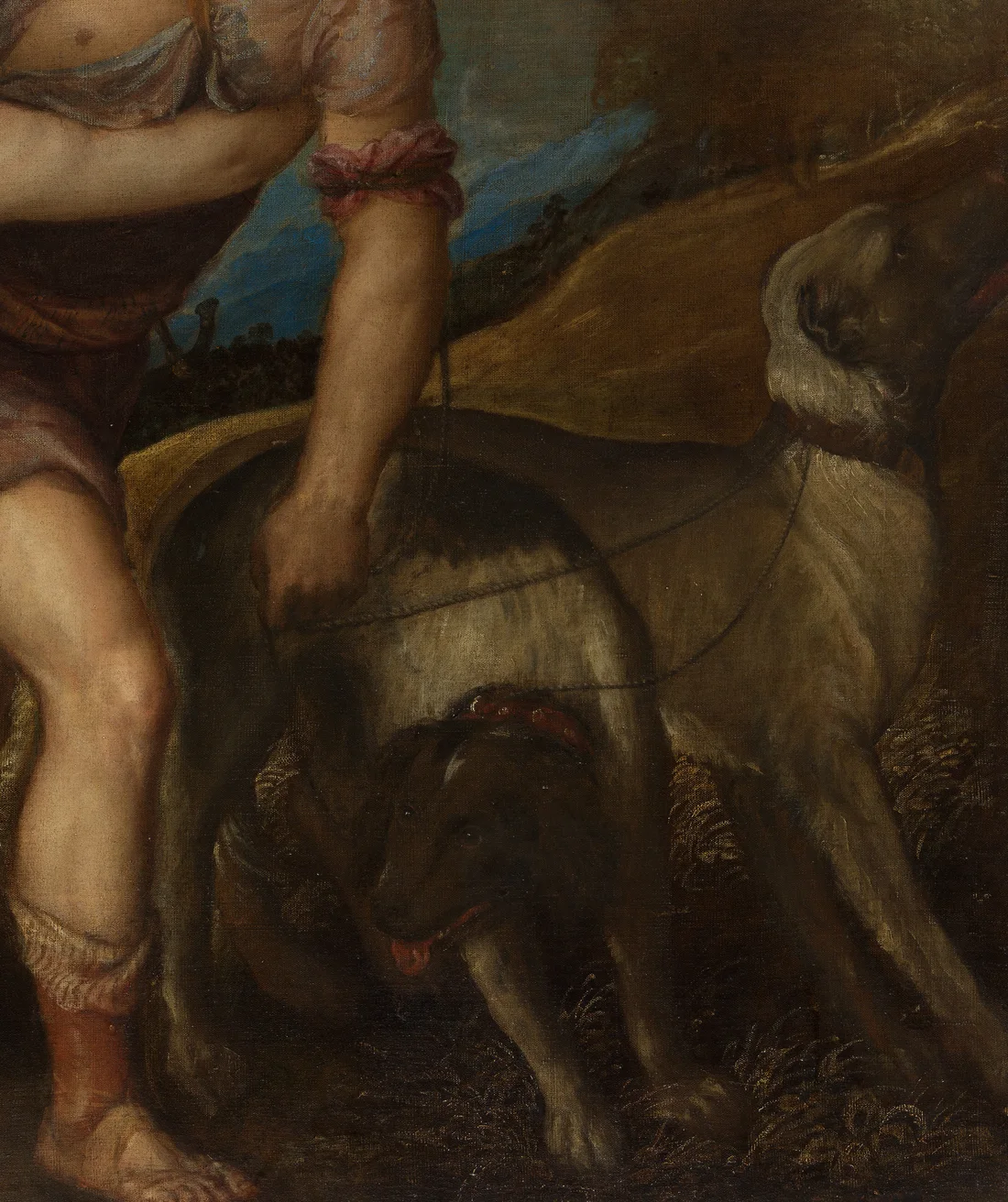
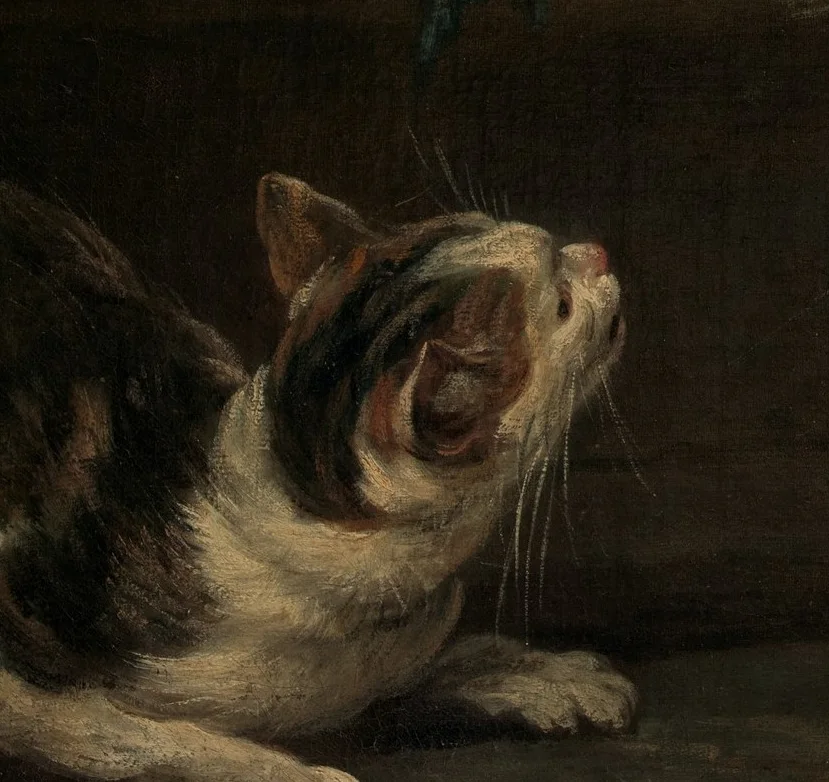
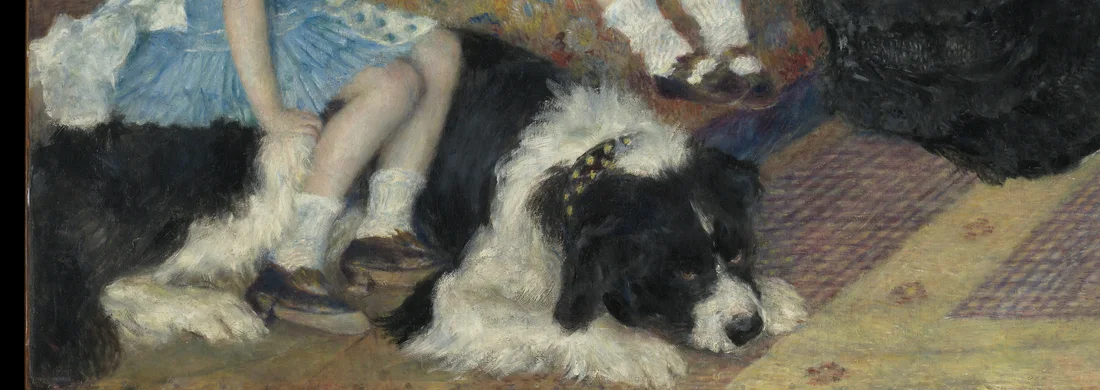
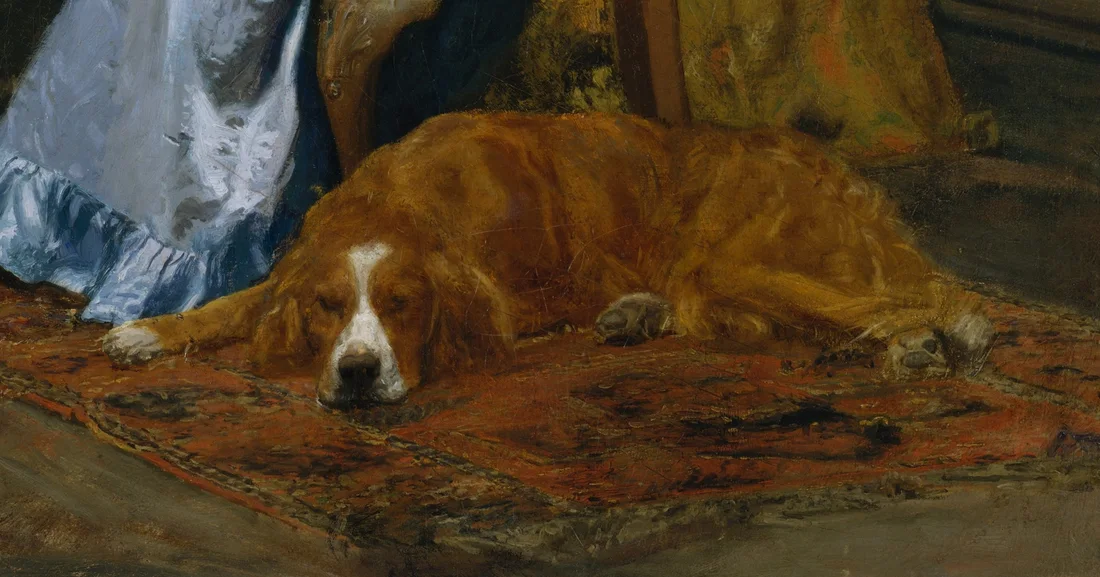
Titian’s hounds strain against the leash. Chardin’s cat stalks. Peake’s greyhounds wait while a prince cuts a deer’s throat. Goya’s cats watch prey. Bonheur’s hound stands to attention, ears up, at work.
Then, in the last two pictures, something happens that has not happened once in three hundred years.
The animal goes off duty.
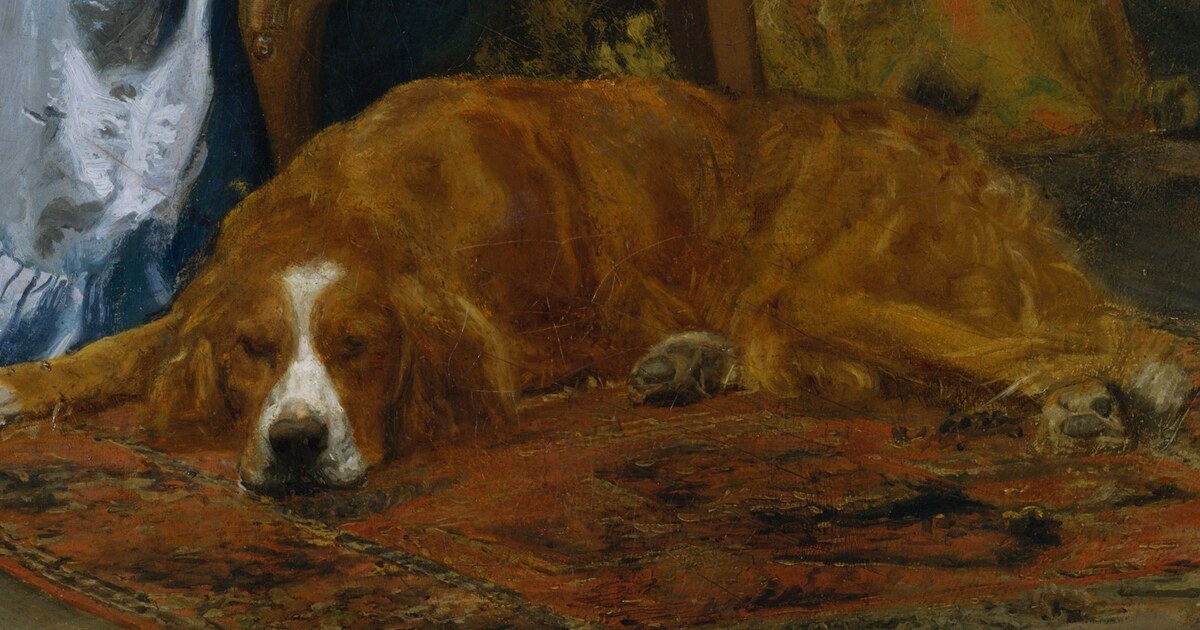
Renoir’s dog is flat on the carpet of a Paris drawing room being used as furniture — six-year-old Georgette Charpentier is sitting on his flank with her feet on the floor, and he is putting up with it. Eakins’s setter is fully asleep across the bottom third of the canvas, chin on a Persian rug. Neither is guarding, hunting, herding or performing. They are at rest in a warm room because nothing in the room is going to hurt them.
That is what a pet is, and you can see it. An animal painted with nothing to do is an animal that has been let all the way inside.
Four hundred years, in four moves
1. The animal as instrument
In Titian’s Venus and Adonis the dogs are the force pulling Adonis away from Venus toward the hunt that will kill him. Robert Peake’s Henry Frederick, Prince of Wales (1603) works the same way: greyhounds held at the right edge while a nine-year-old prince performs the ritual first cut on a killed deer. The dogs are equipment. Expensive, beautiful, and equipment.
It is worth pausing on what these dogs did not mean. You will read everywhere that a dog signifies fidelity, cited to the little dog in van Eyck’s Arnolfini Portrait and Erwin Panofsky’s famous 1934 article. Panofsky hedged it himself — in a footnote to that very article he called such symbols “almost always ‘ambivalent’” and allowed that the dog reads perfectly well as a plain genre motif.
Then the paint settled it. When the National Gallery examined the panel with infrared reflectography, the most symbol-laden objects in the picture turned out not to be in van Eyck’s design at all. Lorne Campbell, in the Gallery’s own catalogue: “No underdrawing can be found for the oranges, the beads, the two pairs of pattens, the dog or the chandelier.” They were painted in late. The same catalogue rejects the wedding reading outright, and of the dog says only that it “is clearly a household pet”.
The most interpreted animal in Western art was an afterthought, and the museum that owns it thinks it is somebody’s pet.
2. The animal as intruder
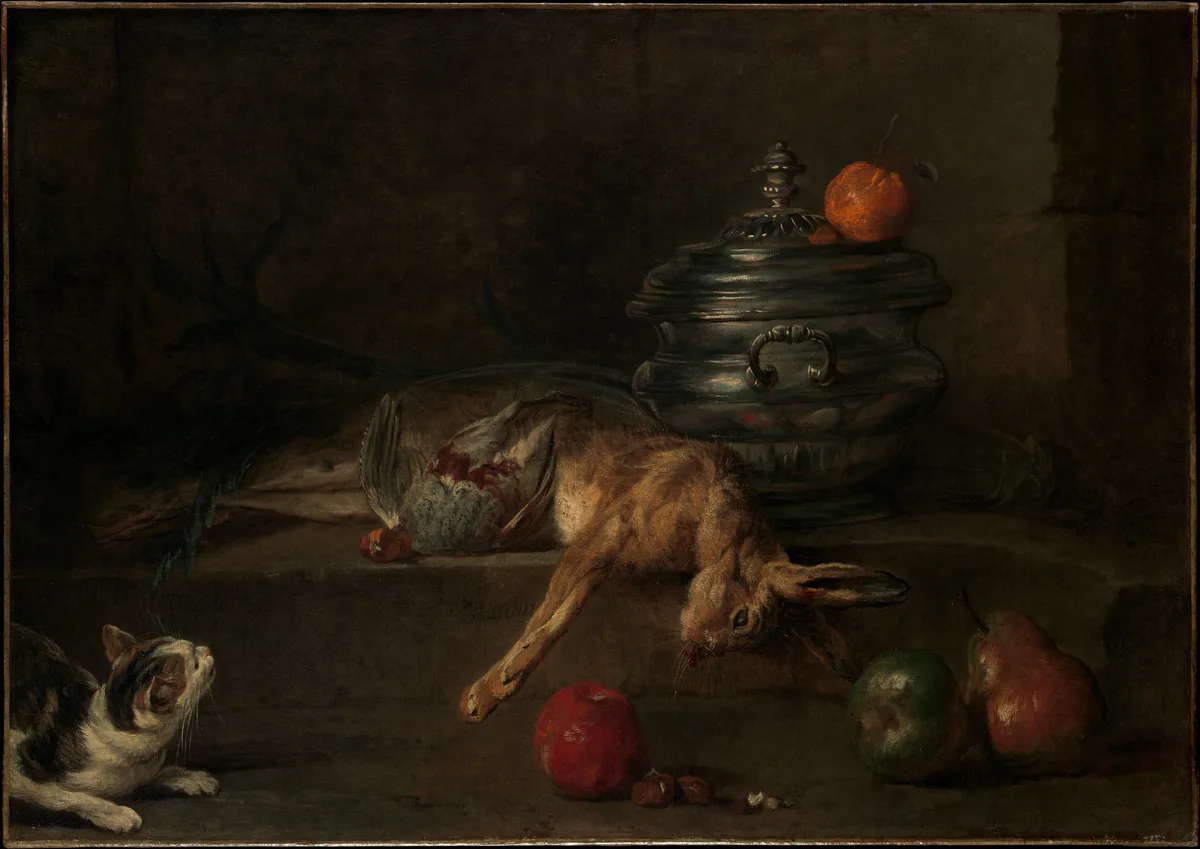
Cats arrive later, and worse. Chardin’s cat is the most literal image in this whole sequence: it is entering the painting from outside, its body cut by the left edge, creeping toward a dead hare. Not a member of the household — a thief who has got in.
Annibale Carracci’s Two Children Teasing a Cat (1587–88) is stranger. The cat is superb, ears flattened, entirely convincing as a specific annoyed animal watched closely by someone who knew cats. And the picture’s subject is two children tormenting it with a crayfish for fun. Carracci could see the cat perfectly. He just did not think its distress was the point.
The contrast is not within Europe. On 11 March 889 the Japanese emperor Uda set down a fond, close description of his black cat — the earliest known Japanese record of a kept pet cat, some six centuries before European painting produced anything comparable in tone.
3. The animal as property
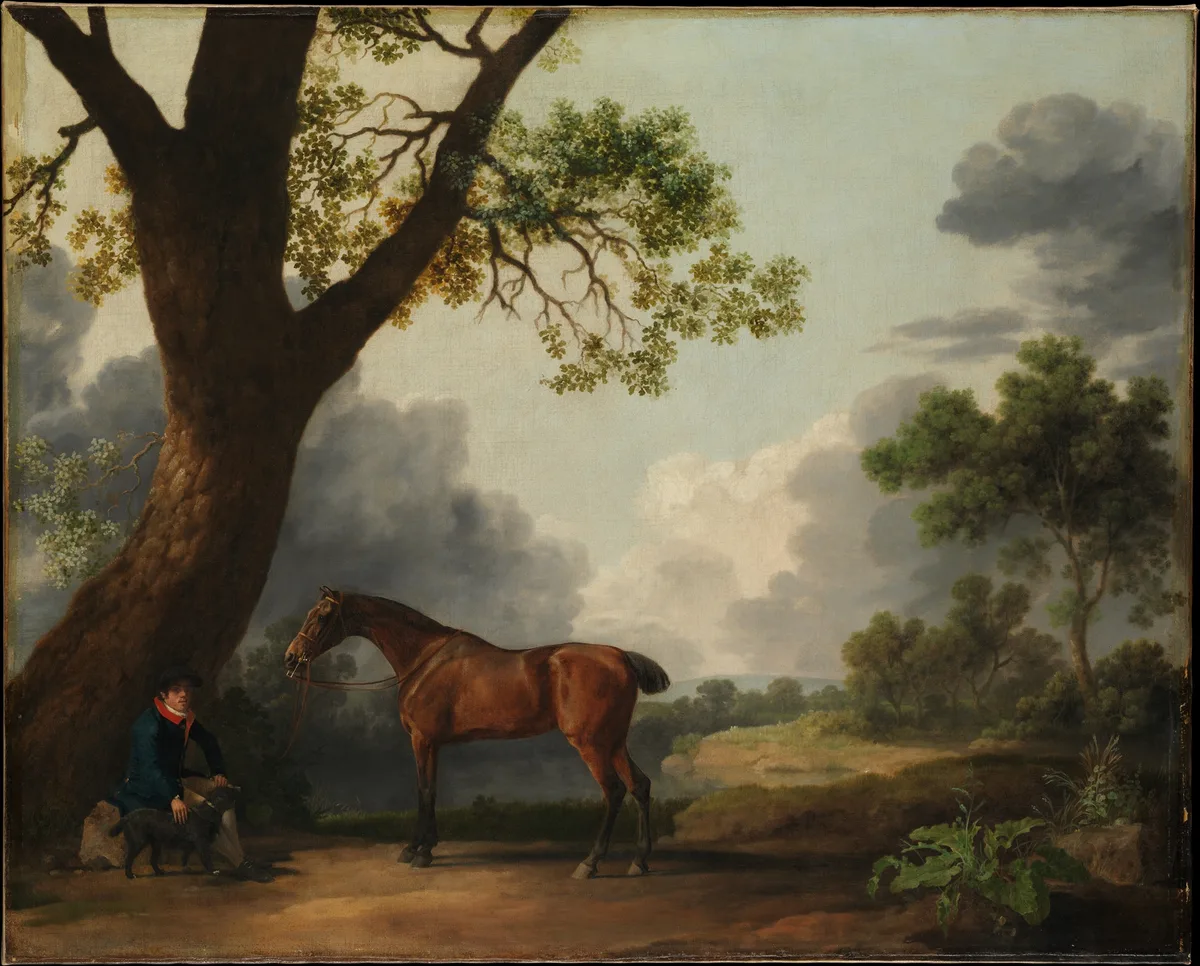
The first animals to earn a portrait earned it by being valuable. The hierarchy of the Stubbs is the hierarchy of the estate ledger — and it was well-paid work, not a marginal trade. One of his most famous racehorse commissions came from William Wildman, a Smithfield meat dealer, which tells you the money in eighteenth-century horseflesh was not confined to the aristocracy. In 1799, aged about seventy-five, Stubbs sued a baronet for non-payment.
He was still, institutionally, second-class. Joshua Reynolds, in his fourth Discourse of 1771, lumped animal painting in with portraiture, landscape and still life as “these humbler walks of the profession”. And Stubbs, contrary to what you will read almost everywhere, was never a Royal Academician: elected in 1781, he refused to deposit the required diploma work, the election was annulled — and he went on putting “RA” after his name in the exhibition catalogue anyway.
4. The animal as family
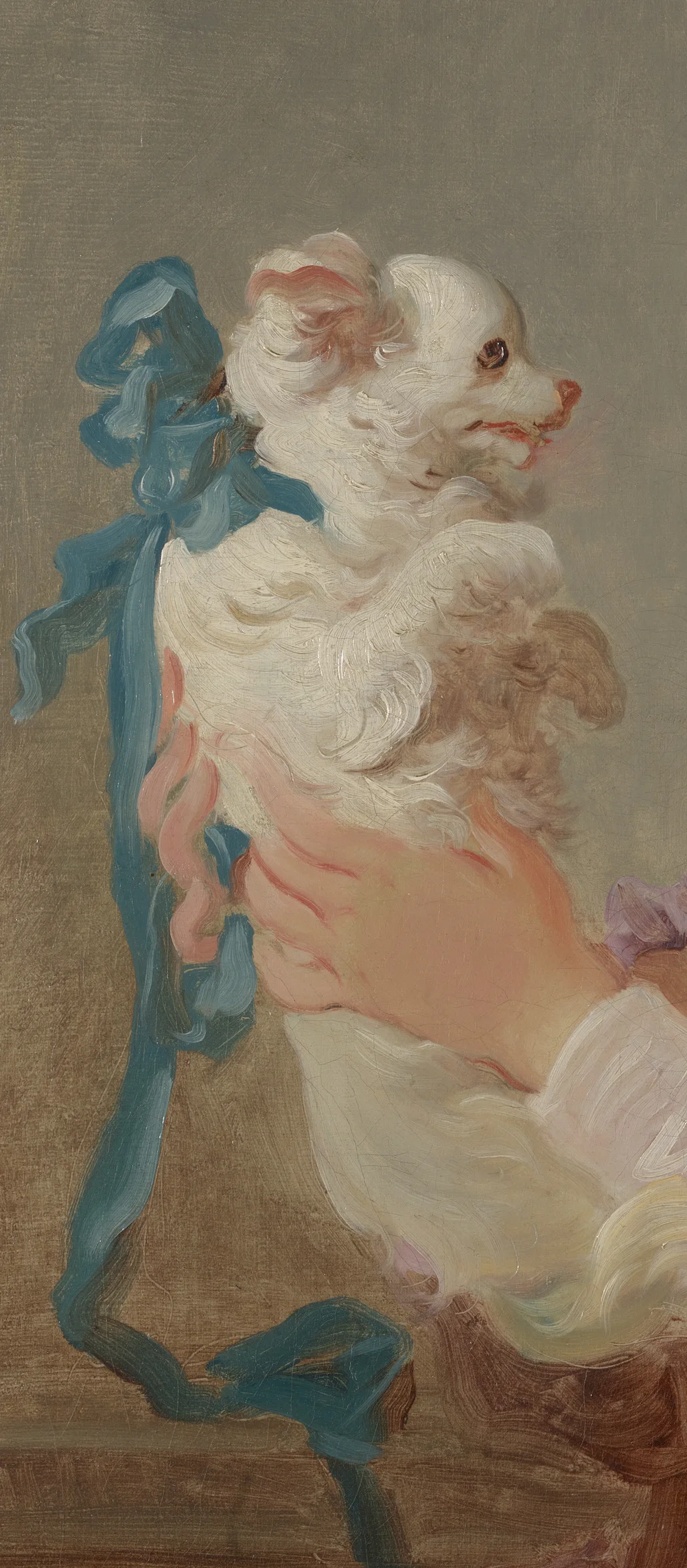
Then people start painting animals they simply liked. Fragonard’s Marie Emilie Coignet de Courson is the hinge of the whole story: a small white lapdog held up at her own eye level, the two of them looking directly at one another. Blue ribbon, no function, no purpose in the picture beyond being adored. Nothing in Titian or Peake or Chardin looks remotely like this.
Goya’s Manuel Osorio Manrique de Zuñiga (1787–88) hands the animals the entire meaning. Three cats watch a magpie the child holds on a string; a cage of finches sits at his feet. Every pair of eyes in the lower half of the canvas belongs to an animal, and the child standing between the predators and the prey has no idea.
And in about 1856 Rosa Bonheur paints one dog, in a wood, with no human anywhere and no story to justify it. The Met’s only subject tag for the object is “Dogs.”
Canter.
The best thing we found is not in any of the famous pictures.
In 1790 a New England woman called Molly Wales Fobes sat for Rufus Hathaway, a travelling painter. The portrait is crowded with animals — a parrot on a hoop, a small bird on the chair back, two butterflies, and a black cat in the bottom left corner. A modest painting, by a modest artist, for a woman of no particular fortune.
Down in that corner, beside the cat, in white script in the same hand as the signature:
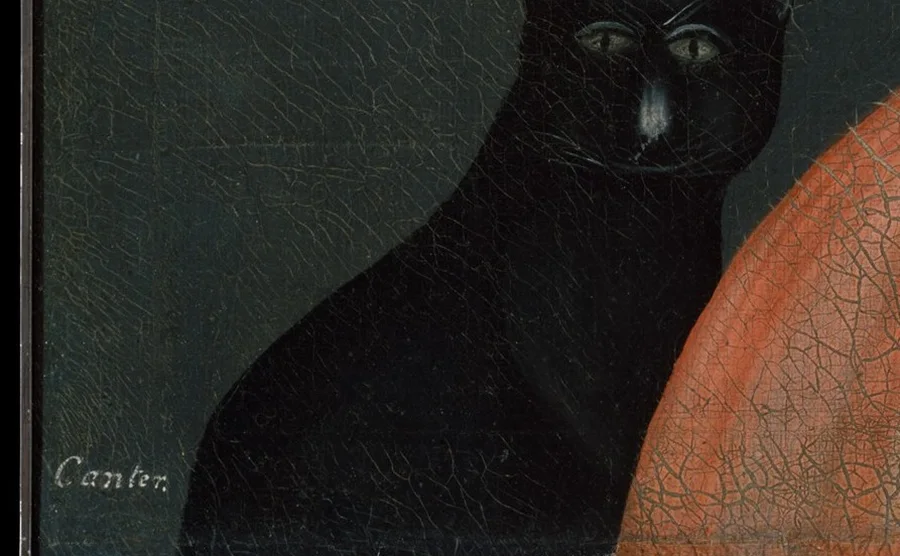
It sits at the cat’s shoulder, in a painting where nothing else is labelled, and the obvious reading is the one you have already reached. Two hundred and thirty-six years ago, somebody paying for a portrait made sure the painter wrote down what the cat was called.
That is the whole history of pet portraiture in one word, in a corner, in a picture nobody queues to see.
The honest complication
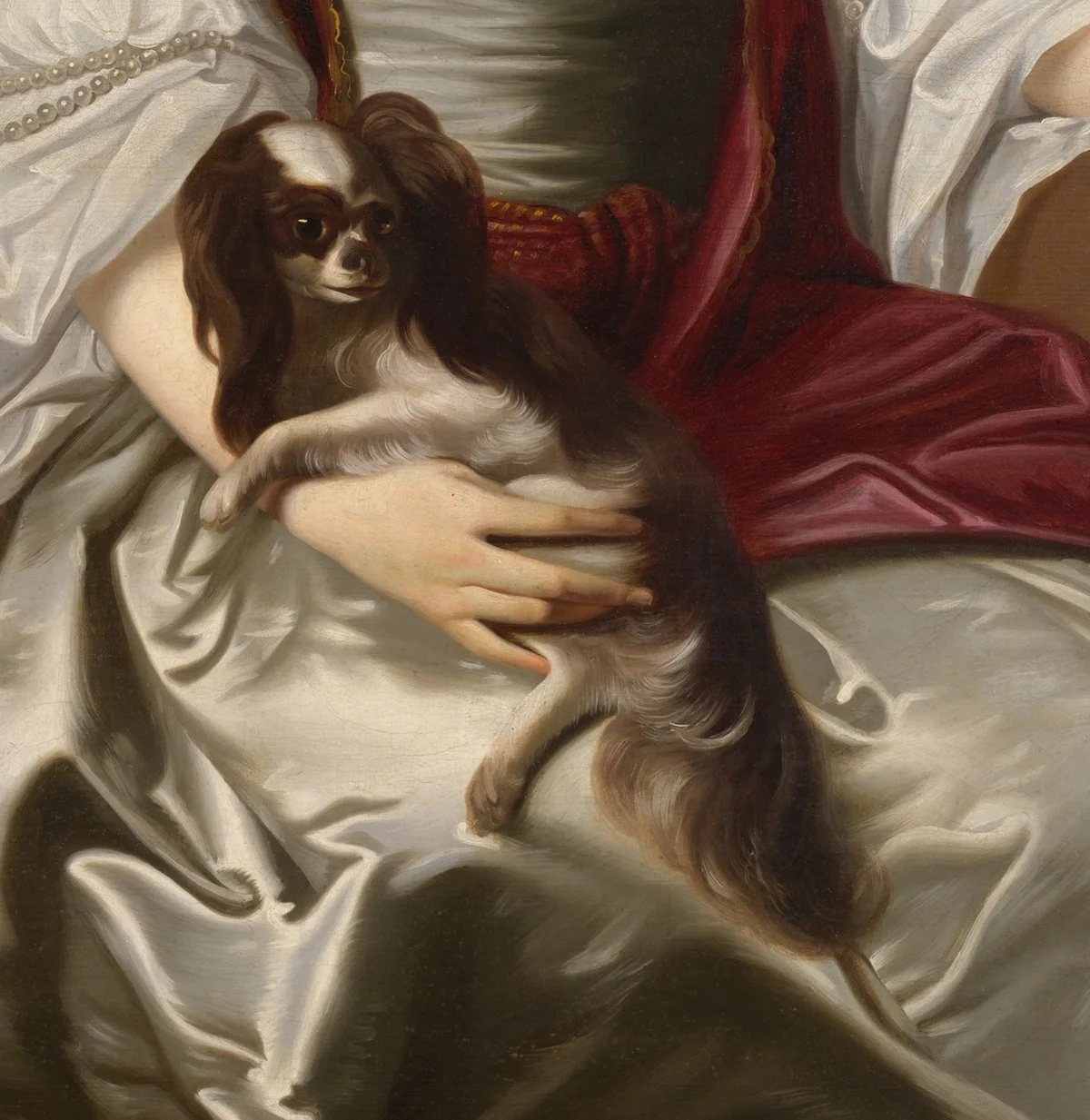
Not every dog in a portrait was ever there.
Copley’s Mrs. Jerathmael Bowers has a King Charles spaniel across the sitter’s lap, holding your eye rather better than the sitter does. It was not her dog. The pose — sitter, dress, spaniel and all — is lifted from a British mezzotint after Joshua Reynolds. A colonial client in Massachusetts bought a fashionable English portrait, and the dog came with the pattern.
This was normal. The Getty curator Elizabeth Morrison has traced one distinctive dog — red ears, spots on a white coat, a feathery tail — through almost a dozen manuscripts illuminated by Simon Bening and his workshop: asleep in a patch of sunlight in one, trotting down a street in another, carried as a puppy in a third. So when you see an animal in an old portrait, you cannot assume it was that person’s animal without evidence — which makes the ones we can verify worth far more.
What to carry away
The animal is the last thing anyone describes. For the Stubbs, the Met’s entry covers the horse, the groom, the oak and the burdock, and never the dog. For Peake’s hunting portrait, the texts discuss the dead deer and not the greyhounds. For Oudry’s Dog Guarding Dead Game — where the dog is the only living thing — the entry names the dead birds species by species and says nothing about the dog beyond repeating the title.
Posture beats prominence. Scale is noise. Working or resting is signal.
Somebody had to pay. Every picture here exists because a person decided an animal was worth the cost of paint — kings recording hunting stock, a meat dealer recording his racehorse, and a woman in Massachusetts in 1790 making sure the painter got the cat’s name right.
The last of those is the one that survived. Wanting a picture of this particular animal is older than photography, older than the modern idea of a breed, and a good deal older than most people assume.
We make custom pet portraits from your own photograph, printed on canvas — nine themed styles, including a renaissance-style portrait that borrows its staging from pictures like these. If yours is a cat, start with the cat portrait before-and-afters.
The twelve paintings, with attributions and links to The Met
All twelve are in the Metropolitan Museum of Art and in the public domain. Titles, attributions, dates and accession numbers are the Met’s own.
Titian (Tiziano Vecellio), Venus and Adonis, 1550s.
Two hunting hounds — straining. 22.0% of the canvas.Annibale Carracci, Two Children Teasing a Cat, 1587–88.
A tabby cat — flinching. 13.7% of the canvas.Robert Peake the Elder, Henry Frederick (1594–1612), Prince of Wales, with Sir John Harington (1592–1614), in the Hunting Field, 1603.
Two greyhounds — waiting. 9.2% of the canvas.Jean Siméon Chardin, The Silver Tureen, ca. 1728–30.
A cat — stalking. 4.4% of the canvas.George Stubbs, The Third Duke of Dorset's Hunter with a Groom and a Dog, 1768.
A hunter (horse), with a small dog — standing. 9.9% of the canvas.Jean Honoré Fragonard, Marie Emilie Coignet de Courson (1716–1806) with a Dog, ca. 1769.
A beribboned lapdog — held up, meeting her eye. 9.7% of the canvas.Goya (Francisco de Goya y Lucientes), Manuel Osorio Manrique de Zuñiga (1784–1792), 1787–88.
Three cats, a magpie, and caged finches — watching prey. 7.3% of the canvas.Rufus Hathaway, Molly Wales Fobes, 1790.
A black cat, a parrot and a small bird — sitting, alert. 3.8% of the canvas.George Caleb Bingham, Fur Traders Descending the Missouri, 1845.
A tethered black animal — sitting, alert. 0.8% of the canvas.Rosa Bonheur, A Limier Briquet Hound, ca. 1856.
A limier briquet hound — standing, attentive. 51.7% of the canvas.Auguste Renoir, Madame Georges Charpentier (Marguerite-Louise Lemonnier, 1848–1904) and Her Children, Georgette-Berthe (1872–1945) and Paul-Emile-Charles (1875–1895), 1878.
The family dog — at rest, being sat on. 13.8% of the canvas.Thomas Eakins, The Artist's Wife and His Setter Dog, ca. 1884–89.
An Irish setter — asleep. 13.8% of the canvas.
Method, sources, and what we are not claiming
The share-of-canvas figures were measured by drawing a rectangle around the animal on the Met’s full-resolution image of each painting and expressing it as a percentage of total image area. Where a picture holds several animals of the same kind — Goya’s three cats, Titian’s pair of hounds — the rectangle encloses the group. The boxes were placed by eye, not by software: accurate to within a few per cent, which is ample for the point being made and not good enough for anything finer. Twelve paintings chosen for an argument are an illustration, not a sample, and nothing here is a statistical claim about European art.
Attributions, dates, media and accession numbers come from the Met’s Open Access collection records. Reading “Canter.” as the cat’s name is our inference from the inscription’s position, not a museum attribution; the Met records only that the inscription exists. Where scholarship is contested — the Arnolfini dog, the identity of Bingham’s animal, the name and breed of Renoir’s dog, which the Met does not give — we have said so rather than picking the tidier version.
Images are reproduced under the Metropolitan Museum of Art’s Open Access policy (CC0). We are grateful for it.