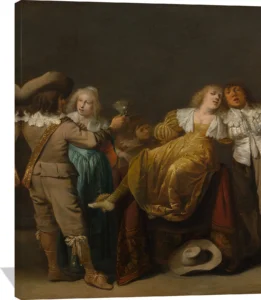
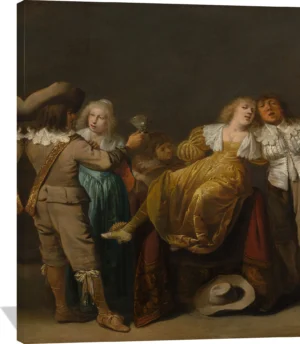
Pieter Jansz. Quast (Amsterdam, 1605/6–1647) was a distinctive voice in Dutch Golden Age art, celebrated for his sharp observational eye and wry sense of humor. Active in Amsterdam and The Hague, he created drawings, prints, and paintings that captured everyday life with a lively, often satirical edge.
Artistic Style and Approach
Subjects and Themes
He is best known for genre scenes populated by soldiers, peasants, beggars, and entertainers, often depicted in humorous or revealing situations. These everyday figures were not merely comic relief; Quast used them to illuminate social dynamics and human behavior with both empathy and wit. Though he also produced religious and allegorical works, his most enduring subjects remain the lively street characters that lend his art its distinctive charm.
Legacy and Significance
Quast’s drawings and prints circulated widely, contributing to the visual culture of 17th-century Holland. His ability to distill human quirks into expressive, economical forms influenced later artists who embraced character studies and satirical imagery. Today, his work is admired for its clarity, inventive spirit, and its unfiltered look at the vibrancy of daily life. Quast’s art endures as a testament to the Dutch Golden Age’s fascination with portraying the world not only as it appeared, but as it felt spirited, flawed, and profoundly human.