Artistic Style
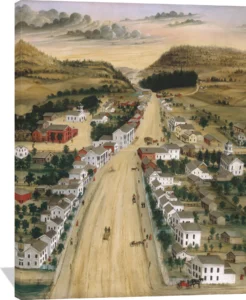
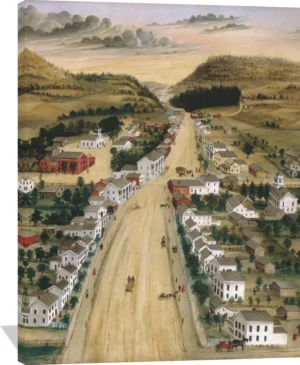
Hidley’s paintings are marked by clear linear definition, balanced compositions, and a luminous palette that brings a gentle clarity to his scenes. His style aligns with the American folk and vernacular painting traditions of his era, distinguished by its directness, simplicity of form, and deliberate rendering of architectural and natural elements. These qualities give his works a quiet immediacy and a sense of place that remains compelling.
Subjects and Themes
He is best known for his detailed townscapes, homesteads, mills, and rolling Northeastern vistas. Hidley frequently depicted the built environment within the broader landscape, emphasizing the relationship between rural communities and the natural world. Seasonal shifts, clear skies, and calm water surfaces recur throughout his work, revealing his attentive engagement with the rhythms of everyday life.
Notable Contributions
Although he did not achieve widespread fame during his lifetime, Hidley’s paintings have since become valued records of nineteenth‑century American life. His scenes offer authentic glimpses of small‑town architecture and agrarian settings at a moment of transition in regional history. Today, his ability to merge documentary clarity with a uniquely personal vision is recognized as a significant contribution to American folk art.
Cultural Significance
Hidley’s work holds enduring historical value. It preserves the visual identity of communities that were evolving with the century’s social and economic shifts. His paintings stand as both artistic expressions and cultural documents, offering insight into how ordinary landscapes were experienced, understood, and idealized in nineteenth‑century America. Through this duality, Hidley remains a distinctive voice within the tradition of American folk painting.