Artistic Style
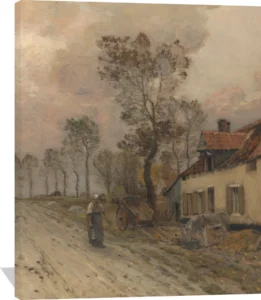
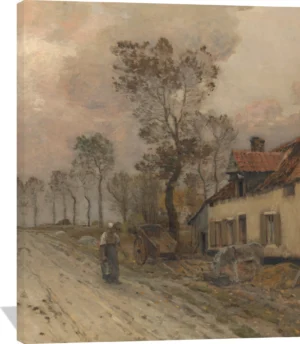
Cazin’s work is defined by soft tonal harmonies, delicate transitions of light, and a refined sense of calm. His paintings often evoke twilight or early dawn, capturing moments when the landscape shifts subtly between day and night. This signature approach places him among the notable Tonalists of the late nineteenth century, while his sensitive handling of composition gives his canvases a contemplative, almost meditative quality.
Subjects and Themes
Although he created religious and historical compositions earlier in his career, Cazin became best known for serene landscapes inspired by Northern France and the Mediterranean coast. Country roads, quiet fields, small villages, and coastal horizons appear frequently in his work, sometimes paired with understated narrative elements. Even when depicting humble subjects, he imbued each scene with a sense of poetic stillness, allowing modest settings to convey emotional depth.
Contributions and Significance
Cazin played an important role in late nineteenth‑century French painting, bridging naturalism with a more introspective, atmospheric sensibility. His refined treatment of light influenced younger artists, and his work was admired for its balance of realism and mood. Today, collectors value his ability to transform everyday landscapes into timeless visual poetry, marked by restraint, elegance, and emotional resonance.