Artistic Style
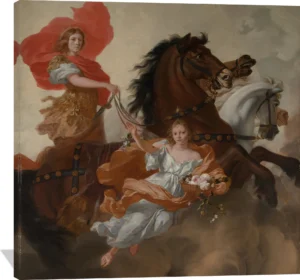
De Lairesse brought a distinctly classical vision to a period still strongly influenced by realism. His paintings display harmonious compositions, smooth finishes, and carefully idealized figures. Drawing inspiration from French classicism and Italian Renaissance masters, he cultivated an elevated, theatrical style that set him apart from many contemporaries. His disciplined approach and emphasis on orderly design later earned him the reputation as the Dutch counterpart to Poussin.
Subjects and Themes
He was celebrated for grand historical and mythological scenes, allegories, and large decorative cycles intended for elite patrons. Works such as Allegory of the Five Senses and his various ceiling and mural commissions reveal his ability to transform narrative subjects into elegant, dynamic arrangements. He also produced religious imagery, portraits, and etchings, all characterized by clarity, balance, and intellectual intent.
Legacy and Significance
De Lairesse’s influence extended far beyond his painted oeuvre. After becoming blind later in life, he turned to theory, authoring the seminal treatises Groot Schilderboek and Grondlegginge der Teekenkonst, which shaped artistic education in the Netherlands for generations. His writings championed reason, ideal beauty, and narrative coherence, marking him as a central voice in the shift toward a more academic and classically oriented Dutch art.
Today, Gerard de Lairesse is recognized for his distinctive blend of intellectual rigor and visual elegance a legacy that continues to offer insight into the evolution of European classicism.