Artistic Style
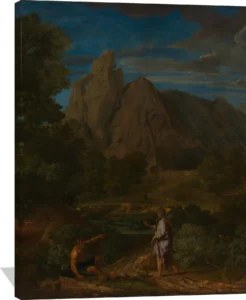
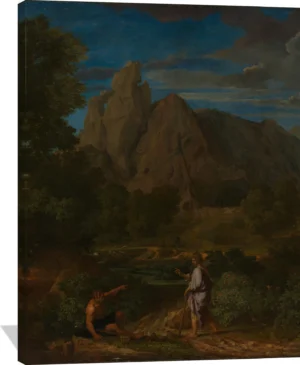
Millet’s paintings are marked by luminous skies, soft tonal transitions, and carefully orchestrated spatial depth. Influenced by earlier Dutch and Flemish landscapists, he developed a distinctive approach that emphasized harmony over drama. His brushwork is restrained yet expressive, creating a sense of quiet grandeur. Many of his scenes embody the aesthetics of the classical landscape tradition, where nature appears ordered, contemplative, and subtly heroic.
Typical Subjects
Pastoral views, wooded clearings, and distant architectural elements are central to Millet’s oeuvre. He frequently populated his landscapes with small figures, shepherds, or travelers, allowing the natural world to remain the true subject. These figures serve as gentle anchors within expansive terrains filled with softly rendered trees, glowing horizons, and atmospheric perspective.
Notable Contributions
Millet’s ability to merge Dutch realism with the compositional ideals of French classicism positioned him as a key contributor to the evolution of seventeenth‑century landscape painting. His scenes possess a rhythmic balance that influenced subsequent generations seeking to reconcile naturalistic detail with idealized beauty. Widely admired in his time, his works circulated among collectors who valued the subtlety and meditative quality of his landscapes.
Cultural Significance
Although his life was brief, Millet left a meaningful legacy: a body of work that reflects both the cosmopolitan artistic exchanges of his era and the emerging taste for tranquil, ordered nature. Today, he is remembered for his refined landscapes and his ability to transform everyday scenery into enduring poetic visions. His paintings continue to appeal to those drawn to timeless settings rendered with grace and atmospheric depth.