Artistic Style
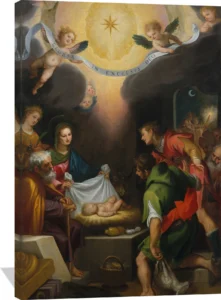
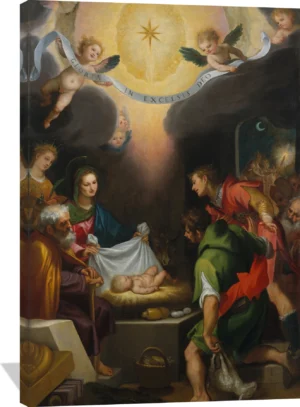
Cigoli’s work is distinguished by its graceful blend of Mannerist elegance and emerging Baroque realism. His figures carry a heightened sense of humanity, rendered with soft modeling, nuanced light, and refined psychological expression. This synthesis allowed him to move beyond the artificiality of earlier Mannerism while avoiding the dramatic extremes that would later define full Baroque painting.
Notable Contributions
Highly regarded in his lifetime, Cigoli was commissioned by prominent patrons, including the Medici and the papal court. His frescoes and altarpieces helped shape the visual language of the Counter-Reformation, emphasizing clarity, devotion, and accessible emotion. Cigoli also made contributions to scientific illustration, most notably creating one of the earliest accurate depictions of the Moon’s surface after Galileo’s telescopic observations, a testament to his curiosity and interdisciplinary engagement.
Subjects and Themes
Cigoli’s oeuvre centers on sacred narratives, portrayals of the Virgin Mary, and scenes from the lives of saints, often infused with quiet drama and luminous atmospheres. His attention to natural detail and expressive gesture allowed him to convey complex spiritual themes with striking immediacy. In addition to religious works, he produced portraits and allegorical compositions that reveal a keen sensitivity to character and symbolism.
Cultural Significance
Cigoli occupies an important place in the history of Italian art as a bridge between eras. His ability to harmonize ideal beauty with observational realism influenced a generation of artists who sought a more sincere and emotionally resonant visual language. Today, his works stand as exemplars of a pivotal artistic moment, marked by innovation, intellectual curiosity, and a refined, human-centered approach to painting.