Artistic Style
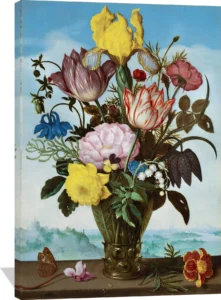
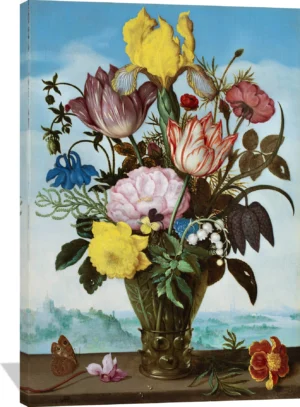
Bosschaert’s paintings are defined by meticulous detail, luminous color, and remarkable compositional harmony. His works often present flowers with scientific precision, arranged in symmetrical bouquets that seem to glow against smooth, neutral backgrounds. The clarity and refinement of his technique helped establish the still-life aesthetic that would influence generations of Dutch painters.
Subjects and Iconography
Specializing almost exclusively in floral compositions, Bosschaert assembled blooms such as tulips, roses, and irises that rarely blossomed simultaneously, creating idealized yet believable botanical portraits. These arrangements frequently include butterflies, insects, or seashells, subtle references to nature’s transience and the era’s fascination with collecting rare specimens. His use of the vase as a centerpiece became a hallmark, grounding each composition with elegant stability.
Legacy and Significance
As one of the earliest artists to form a professional still-life tradition, Bosschaert held a foundational place in the development of Dutch floral painting. He led a family workshop whose influence extended well beyond his lifetime, shaping the visual language of still-life art through both his sons and his brother-in-law, Balthasar van der Ast. His precision, balance, and devotion to botanical beauty make his works enduring favorites among collectors and admirers of the genre.