Artistic Style
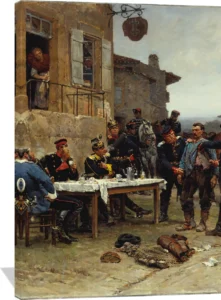
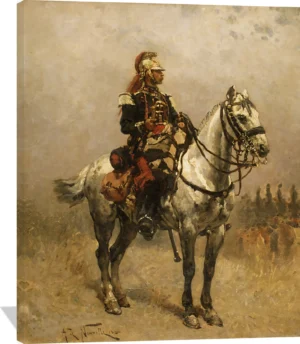
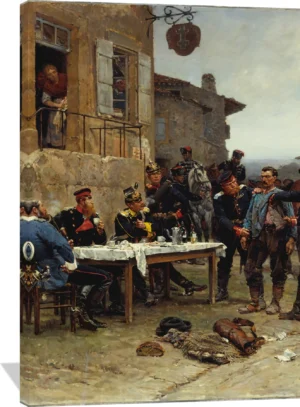
De Neuville specialized in dramatic realism, rendering battlefield scenes with meticulous attention to uniform details, weaponry, and terrain. His palette often favored somber, atmospheric tones that heightened the tension of the moments he portrayed. Through carefully structured compositions and expressive lighting, he communicated both the heroism and hardship of soldiers, creating works that felt immediate and deeply resonant.
Typical Subjects
He is best known for portraying episodes from the Franco-Prussian War, colonial campaigns, and other significant French military events. His scenes frequently capture decisive moments: soldiers defending fortified positions, small units facing overwhelming odds, or quiet intervals of anticipation before combat. Each work underscores the psychological and emotional realities of warfare rather than mere spectacle.
Notable Contributions
As a leading military painter of his generation, de Neuville provided visual narratives that shaped public understanding of France’s modern conflicts. His illustrations and canvases became widely circulated, valued for their authenticity and clarity. Works such as Le Dernier Cartouche earned him lasting recognition, reinforcing his reputation for bringing history to life with cinematic immediacy.
Cultural Significance
De Neuville’s art served as both documentation and commemoration, preserving the experiences of soldiers at a time when national identity and military memory were intensely felt in France. His ability to convey the gravity and dignity of combat made him a central figure in nineteenth-century history painting. Today, his work remains admired for its emotional depth, historical precision, and its role in shaping the visual legacy of modern warfare.