
Saint Cecilia
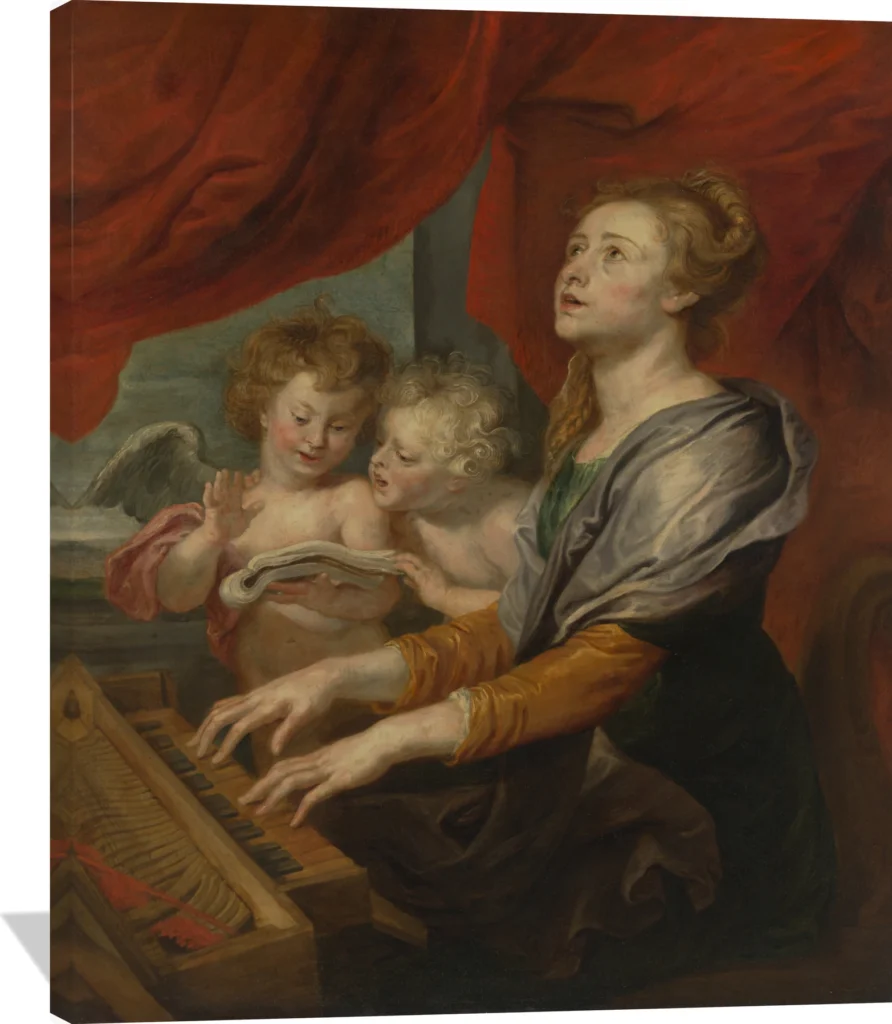
The Abraham van Diepenbeeck Saint Cecilia canvas captures a moment of divine inspiration, as the patron saint of music plays an organ accompanied by cherubic angels. Rich crimson drapery, golden tones, and soft flesh hues create a luminous harmony that evokes Baroque grandeur and spiritual serenity. The vertical composition draws the eye upward, enhancing its uplifting mood.
This exquisite Saint Cecilia wall art brings timeless elegance to any interior. Perfect for a living room, study, or entryway, this museum-quality canvas print celebrates Flemish artistry and the transcendent power of music, transforming your space with warmth and grace.
Abraham van Diepenbeeck (1596–1675) was a distinguished Flemish painter and designer whose career helped shape the artistic landscape of seventeenth‑century Antwerp. Trained within the vibrant milieu of the Antwerp School, he became known for his refined draftsmanship, sophisticated compositional sense, and his ability to move seamlessly between painting, stained‑glass design, and book illustration.
Artistic Style and Approach
Van Diepenbeeck’s work reflects the elegance and expressive clarity characteristic of the Flemish Baroque. His style combines precise, graceful drawing with a measured use of color, resulting in images that feel both dynamic and harmoniously balanced. His command of line made him particularly sought after for designs, while his paintings reveal a thoughtful interplay of light and narrative detail. A hallmark of his work is its refined staging of figures, often arranged with theatrical poise yet infused with a natural sense of movement.
Subjects and Themes
Although versatile, van Diepenbeeck is especially recognized for his religious and mythological scenes, as well as his contributions to allegorical and historical imagery. His figures are often rendered with a sculptural presence, reflecting his deep knowledge of classical forms. In addition to his paintings, he produced influential designs for stained‑glass windows, a medium in which his clarity of line and narrative instinct proved particularly effective. His book illustrations further extended his reach, transforming literary subjects into vivid visual experiences.
Legacy and Significance
A respected member of Antwerp’s artistic community and a collaborator with leading painters of his time, van Diepenbeeck played a meaningful role in disseminating the ideals of the Baroque across different media. His work demonstrates the intellectual richness and technical versatility that defined Flemish art during the seventeenth century. Today, he is remembered for his exceptional draftsmanship and his ability to translate complex narratives into compelling, elegantly structured compositions.
Trust & policies
- 🚚 Free tracked shipping to 45+ countries. Local import duties or taxes may apply in some destinations.
- 🎨 Made-to-order, printed close to your delivery location
- 🛡️ If damaged, defective, or misprinted: free replacement or refund
- 🌍 Printed in US/CA/EU/UK/AU based on delivery location
- 💎 Acid-free, fade-resistant canvas with solid wood stretcher bars
- 🖼️ Optional pine floating frames in white, black, or brown
- 🪝 Ready to hang — hardware pre-installed