
Omnia Vincit Amor, or The Power of Love in the Three Elements
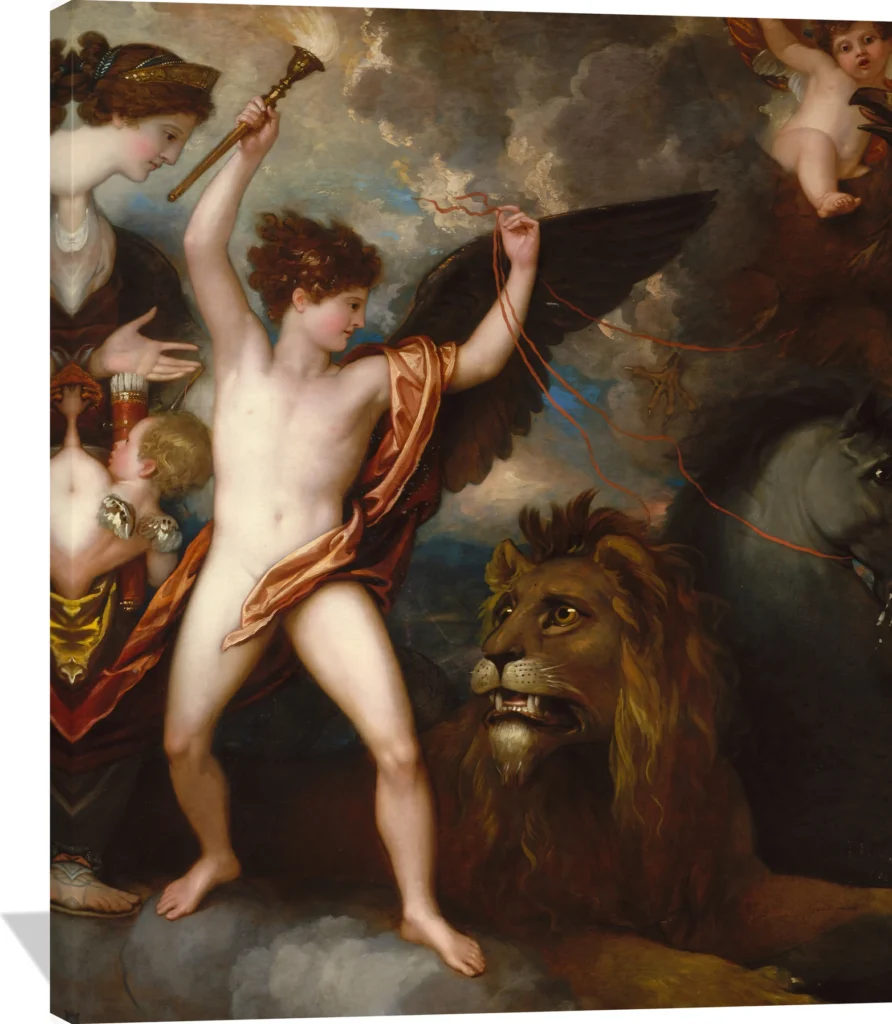
The Benjamin West Omnia Vincit Amor, or The Power of Love in the Three Elements canvas captures a dramatic allegory of love’s triumph over nature. Rich tones of gold, crimson, and deep blue illuminate divine figures and mythic creatures, creating a luminous balance between power and grace. West’s neoclassical mastery infuses the scene with movement and emotion, making it a timeless centerpiece for any refined space.
This museum-quality canvas print brings historical grandeur to modern interiors. Ideal for a living room, study, or entryway, it evokes both serenity and strength—an inspiring statement of beauty and devotion rendered in exquisite detail.
Benjamin West (1738–1820) was an American-born painter from Swarthmore, Pennsylvania, who rose to prominence in London as one of the most influential artists of the late eighteenth and early nineteenth centuries. Celebrated for his commanding historical scenes and refined neoclassical style, West became a pivotal figure in shaping the visual culture of his era.
Artistic Style and Approach
West’s work is distinguished by its harmonious balance of neoclassical clarity and dramatic narrative. He often employed luminous color, controlled composition, and expressive yet dignified figures to convey moral and historical gravity. His ability to merge contemporary events with classical visual language made his paintings both accessible and elevated.
Notable Contributions
As a co-founder and eventual president of the Royal Academy in London, West played a formative role in establishing academic art standards in Britain. His groundbreaking decision to depict modern subjects in contemporary dress most famously in works such as The Death of General Wolfe helped redefine the conventions of historical painting and influenced generations of artists.
Subjects and Themes
West specialized in large-scale historical, biblical, and allegorical scenes, focusing on themes of heroism, sacrifice, and moral virtue. His compositions often highlight pivotal moments that shaped national identity or conveyed timeless ethical narratives.
Cultural and Historical Significance
As one of the first internationally renowned American artists, West bridged cultural worlds. His career demonstrated that an artist from the American colonies could achieve acclaim at the highest levels of the European art world. Through his teaching, leadership, and prolific output, he left a lasting legacy that helped define the trajectory of Western painting during a period of profound artistic and political change.
Trust & policies
- 🚚 Free tracked shipping to 45+ countries. Local import duties or taxes may apply in some destinations.
- 🎨 Made-to-order, printed close to your delivery location
- 🛡️ If damaged, defective, or misprinted: free replacement or refund
- 🌍 Printed in US/CA/EU/UK/AU based on delivery location
- 💎 Acid-free, fade-resistant canvas with solid wood stretcher bars
- 🖼️ Optional pine floating frames in white, black, or brown
- 🪝 Ready to hang — hardware pre-installed