
Landscape with Moses and the Burning Bush
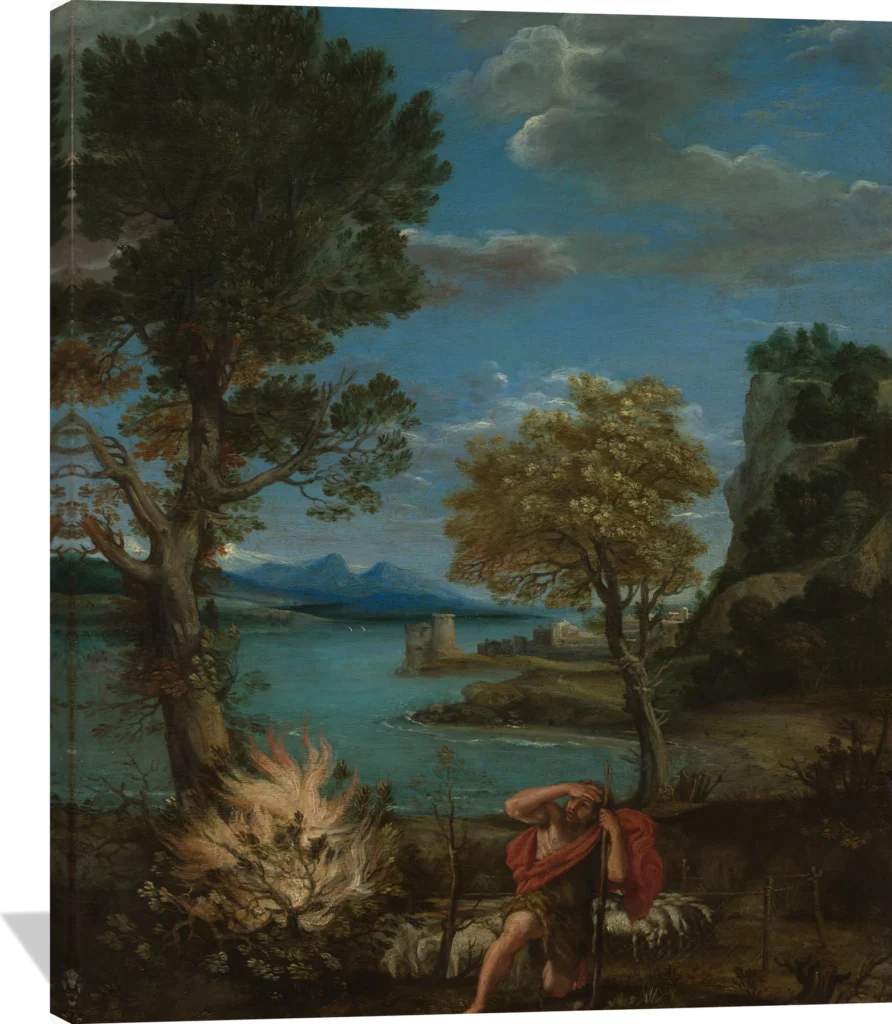
The Domenichino Landscape with Moses and the Burning Bush canvas captures a moment of divine revelation within a serene, luminous landscape. Rich hues of deep green, sky blue, and golden brown frame Moses as he kneels before the miraculous flame, set against a tranquil lake and distant mountains. Domenichino’s masterful balance of light and atmosphere evokes both awe and contemplation.
This museum-quality canvas print brings timeless Baroque elegance to any space. Ideal for a living room, study, or entryway, this wall art invites reflection and adds a touch of classical grandeur to modern interiors.
Domenichino (Domenico Zampieri), born in Bologna in 1581 and active until his death in Naples in 1641, was a central figure of the Italian Baroque whose refined clarity and emotional depth shaped the era’s visual language. Trained within the vibrant Bolognese school, he synthesized the disciplined draftsmanship of his mentors with a lyrical sensibility that made his work both intellectually structured and deeply moving.
Artistic Style and Vision
Domenichino’s style is distinguished by its harmonious compositions, balanced proportions, and masterful control of narrative pacing. He championed a return to compositional clarity and classical restraint at a time when Baroque art often embraced dramatic excess. His paintings exhibit a serene coherence, underpinned by meticulous drawing and a profound understanding of human emotion. His frescoes and altarpieces, in particular, reveal a graceful interplay between figures, landscape, and architectural space.
Notable Contributions
A leading voice in the Carracci-influenced reform of painting, Domenichino elevated the importance of structure and moral clarity in religious art. Works such as The Last Communion of St. Jerome exemplify his ability to translate sacred narratives into visually compelling, psychologically resonant scenes. His contributions to fresco cycles in Rome and Naples remain enduring testaments to his technical versatility and imaginative scope.
Typical Subjects
Domenichino focused primarily on religious themes, classical mythology, and poetic pastoral scenes. His figures often display a quiet nobility, rendered with expressive subtlety rather than overt melodrama. Landscapes play a meaningful role in his compositions, not merely as settings but as atmospheric extensions of the narrative’s emotional tone.
Cultural and Historical Significance
Celebrated by contemporaries and later praised by art historians, Domenichino was regarded as one of the most accomplished painters of his generation. His dedication to clarity of form and expressive restraint positioned him as a key exponent of the classical Baroque, influencing later artists across Italy and beyond. Today, his work is valued for its purity of design, its humanistic sensibility, and its ability to merge intellectual rigor with visual poetry.
Trust & policies
- 🚚 Free tracked shipping to 45+ countries. Local import duties or taxes may apply in some destinations.
- 🎨 Made-to-order, printed close to your delivery location
- 🛡️ If damaged, defective, or misprinted: free replacement or refund
- 🌍 Printed in US/CA/EU/UK/AU based on delivery location
- 💎 Acid-free, fade-resistant canvas with solid wood stretcher bars
- 🖼️ Optional pine floating frames in white, black, or brown
- 🪝 Ready to hang — hardware pre-installed