
The Judgment of Paris
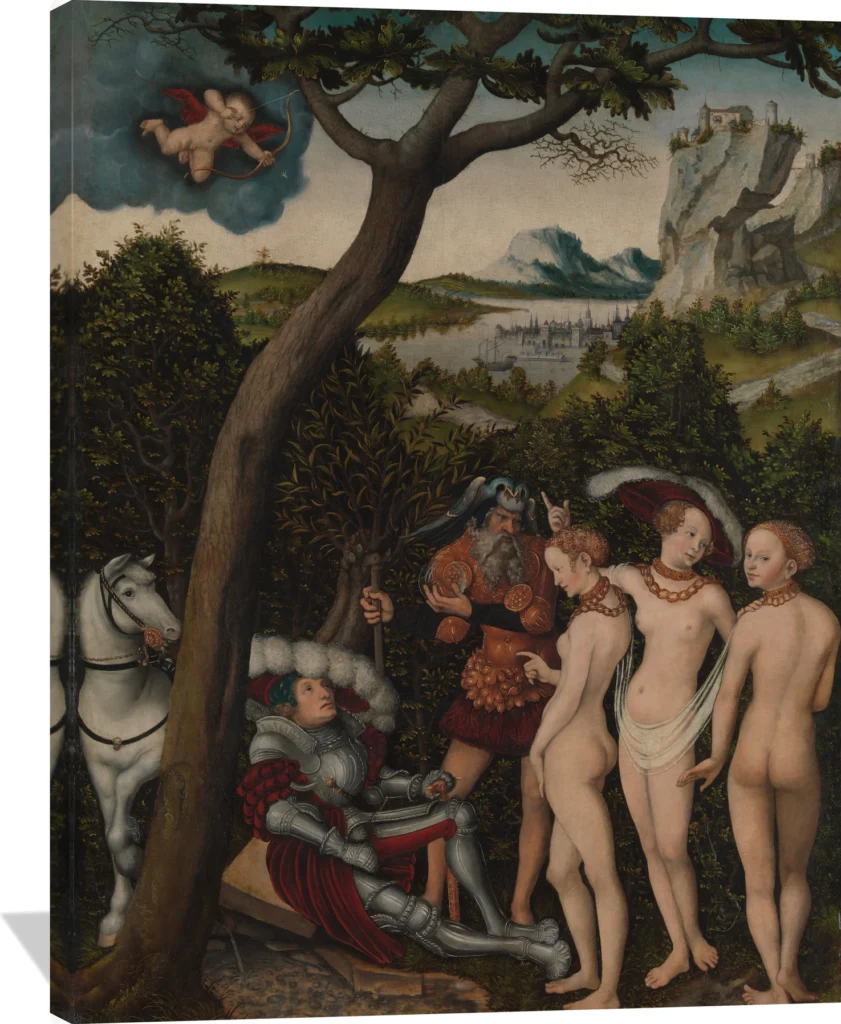
The Lucas Cranach the Elder The Judgment of Paris canvas captures the timeless myth with striking Renaissance detail and poetic grace. Bathed in rich tones of deep green, warm gold, and soft flesh hues, the scene unfolds beneath a sweeping tree as Paris contemplates his fateful choice among three goddesses. Cranach’s refined brushwork and luminous contrasts evoke both sensuality and moral tension, inviting reflection and admiration.
This elegant canvas print brings Old World sophistication to any interior. Perfect for a living room, study, or entryway, this masterful wall art adds a touch of classical drama and enduring beauty to contemporary spaces.
Lucas Cranach the Elder (1472–1553) was a German Renaissance master whose distinctive visual language helped define the artistic spirit of the Reformation era. Born in Kronach and active across major German courts, he became one of the most influential painters, printmakers, and cultural figures of his time. His long career in Wittenberg placed him at the center of Europe’s religious and political transformation, where he served as court painter to the Electors of Saxony and a close associate of Martin Luther.
Artistic Style
Cranach’s style is immediately recognizable for its elegant linearity, refined contours, and luminous color. His figures often embody a graceful yet subtly stylized beauty, marked by elongated forms and expressive gestures. These qualities, combined with his mastery of oil painting and woodcut techniques, give his works a striking clarity and emotional resonance.
Subjects and Themes
His oeuvre spans an impressive range, from mythological and allegorical scenes to court portraiture and religious imagery. Iconic works such as Adam and Eve and Judgment of Paris demonstrate his ability to blend sensuality with moral nuance, while his numerous portraits of Martin Luther helped shape the public image of the Reformation. Cranach’s workshop also produced devotional paintings that convey both spiritual depth and a distinctly human presence.
Legacy and Significance
Cranach’s prolific output and inventive workshop practices established him as a defining figure of Northern Renaissance art. His contributions to printmaking expanded the reach of Reformation ideas, while his portraits documented a transformative period in European history. Today, his work is celebrated for its refined beauty, technical skill, and its vital role in shaping the visual culture of the sixteenth century. As an artist, craftsman, and cultural intermediary, Lucas Cranach the Elder remains a cornerstone of German Renaissance art and a compelling voice of his era.
Trust & policies
- 🚚 Free tracked shipping to 45+ countries. Local import duties or taxes may apply in some destinations.
- 🎨 Made-to-order, printed close to your delivery location
- 🛡️ If damaged, defective, or misprinted: free replacement or refund
- 🌍 Printed in US/CA/EU/UK/AU based on delivery location
- 💎 Acid-free, fade-resistant canvas with solid wood stretcher bars
- 🖼️ Optional pine floating frames in white, black, or brown
- 🪝 Ready to hang — hardware pre-installed