
Weaning the Calves
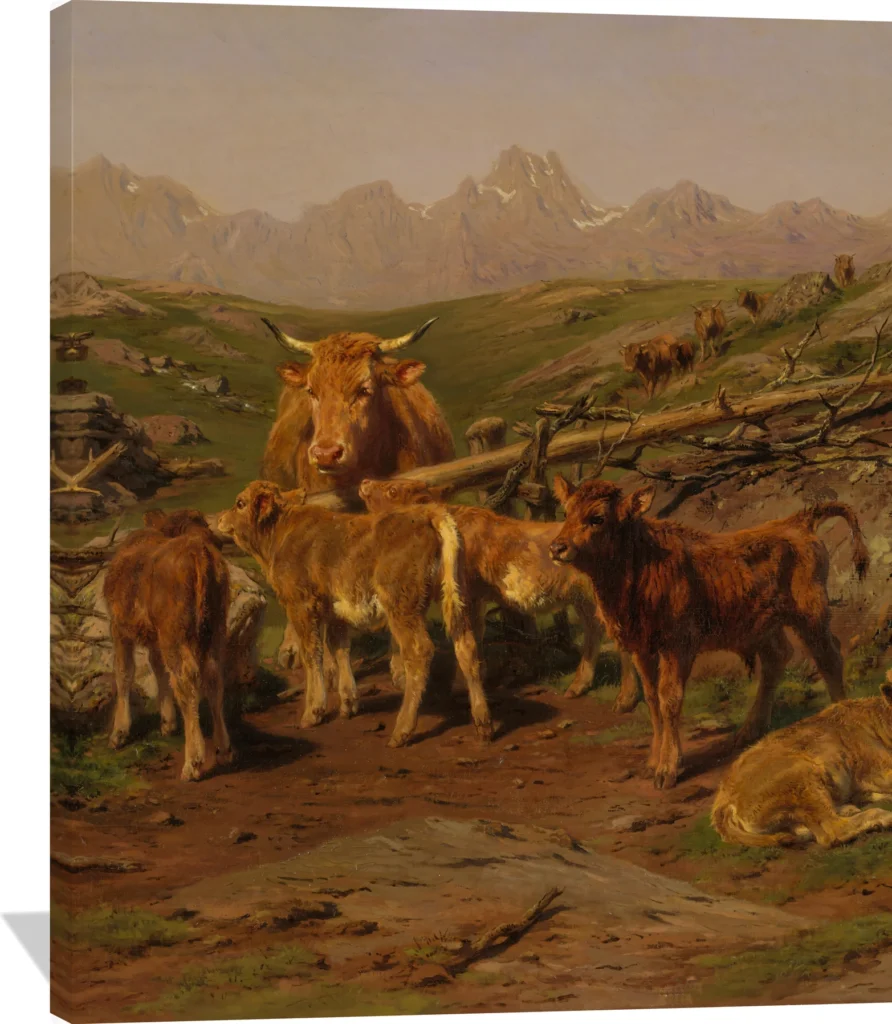
Rosa Bonheur’s Weaning the Calves canvas captures a tender pastoral moment set against a sweeping mountain landscape. Warm earth tones of russet, ochre, and mossy green blend with soft golden light, evoking the calm rhythm of rural life. Bonheur’s masterful realism and sensitivity to animal form bring depth and emotion to this timeless countryside scene.
This exquisite wall art adds a touch of natural grace and quiet strength to any space. Ideal for a living room, study, or entryway, this canvas print celebrates both the beauty of nature and the artistry of one of France’s most beloved painters.
Rosa Bonheur (French, Bordeaux 1822–1899 Thomery) was a pioneering painter celebrated for her vivid and meticulously observed depictions of animals. Recognized in her lifetime as one of the foremost Realist artists of the nineteenth century, she brought an uncommon blend of scientific precision and deep empathy to her subjects, elevating animal painting to new artistic heights.
Artistic Style
Bonheur’s work is defined by its commitment to Realism, characterized by meticulous anatomical accuracy, naturalistic light, and an unembellished depiction of rural life. Her paintings often convey a sense of immediacy, as though captured in motion, reflecting both her rigorous study of animal physiology and her intimate understanding of pastoral environments.
Notable Contributions
Her masterwork The Horse Fair remains one of the most iconic nineteenth-century animal paintings, demonstrating her ability to portray power, dynamism, and character with clarity and grandeur. Through such works, she became a trailblazer for women in the arts, achieving international recognition during a period when female artists encountered significant barriers. Her dedication to authenticity, including observing animals directly in fields, stables, and even slaughterhouses, set her apart from her contemporaries and solidified her reputation as a leading figure of Realist painting.
Subjects and Significance
Bonheur devoted her career to portraying horses, cattle, sheep, and other livestock with both documentary fidelity and emotional resonance. These subjects, rooted in the rhythms of agricultural life, underscore her profound respect for the working animals that shaped nineteenth-century society. Her legacy extends beyond her own canvases; she opened doors for future generations of women artists and established a model of artistic discipline and independence that remains influential today.
Rosa Bonheur’s oeuvre stands out for its fusion of technical mastery and expressive vitality, making her a defining figure in animal painting and a pioneer of Realist art whose work continues to captivate collectors and admirers worldwide.
Trust & policies
- 🚚 Free tracked shipping to 45+ countries. Local import duties or taxes may apply in some destinations.
- 🎨 Made-to-order, printed close to your delivery location
- 🛡️ If damaged, defective, or misprinted: free replacement or refund
- 🌍 Printed in US/CA/EU/UK/AU based on delivery location
- 💎 Acid-free, fade-resistant canvas with solid wood stretcher bars
- 🖼️ Optional pine floating frames in white, black, or brown
- 🪝 Ready to hang — hardware pre-installed