
The Children of Homer Ramsdell, Esq.
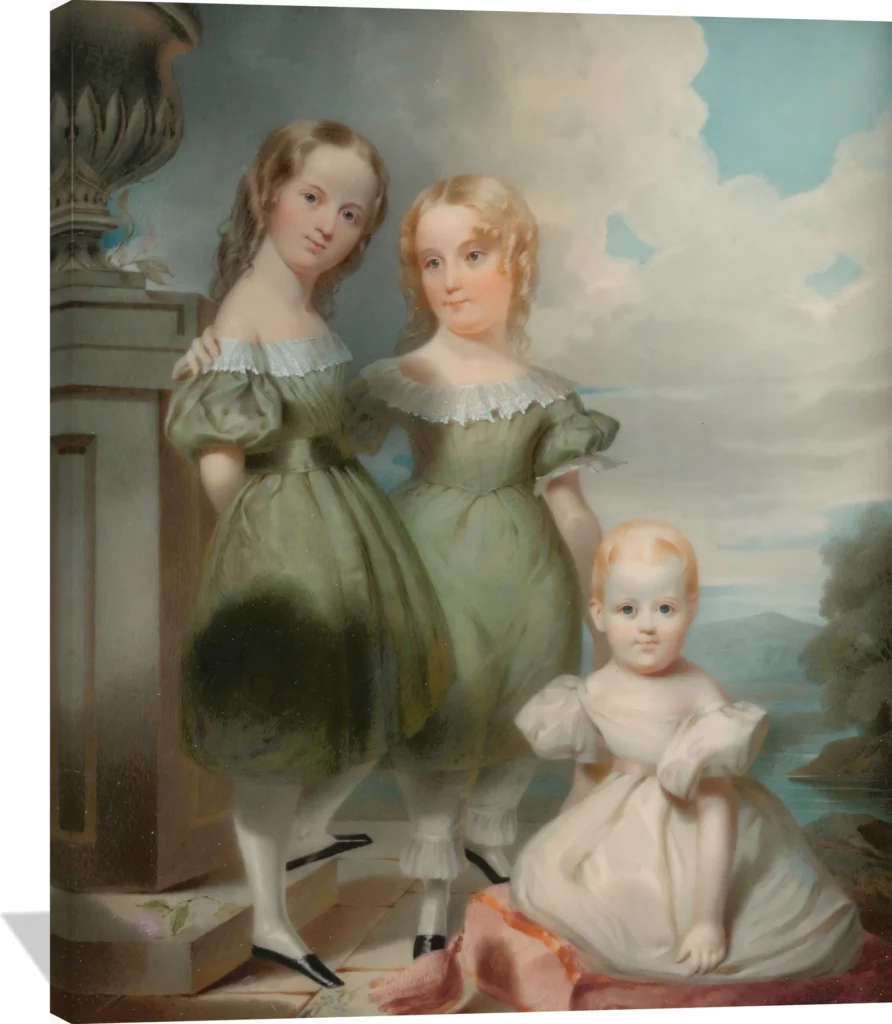
The Thomas Seir Cummings The Children of Homer Ramsdell, Esq. canvas captures a tender 19th-century portrait of innocence and grace. Three children, dressed in soft greens and ivory, are set against a luminous sky and tranquil landscape, their delicate expressions rendered with Cummings’ refined precision. The palette of sage, cream, blush, and sky blue evokes timeless warmth and serenity.
This elegant wall art brings a sense of classical refinement to any interior. Perfect for a living room, study, or entryway, this canvas print celebrates the harmony of family and the artistry of early American portraiture with enduring sophistication.
Thomas Seir Cummings (1804–1894) was an American artist, born in Bath, England, who became one of the leading miniature painters of the nineteenth century. Active primarily in New York, he helped shape the early landscape of American portraiture during a period of rapid cultural growth.
Artistic Style
Cummings was celebrated for his refined miniature portraits, executed with remarkable precision and sensitivity. His work is distinguished by delicate brushwork, subtle transitions of light and shadow, and a focus on psychological presence. This meticulous approach made his portraits highly sought after in an era when miniature painting was a preferred means of personal representation.
Notable Contributions
A pivotal figure in the American art community, Cummings was among the founders of the National Academy of Design, where he also served as an instructor. His efforts helped establish professional standards and educational opportunities for emerging artists. As both a practitioner and a teacher, he played a significant role in elevating the status of American portraiture.
Subjects and Themes
Cummings specialized in intimate likenesses of individuals, often members of prominent families, capturing both fashionable detail and human character. His portraits reveal a careful study of costume, texture, and expression, reflecting his commitment to authenticity and refinement. Many of his works preserve the visual history of nineteenth-century American society.
Cultural and Historical Significance
Cummings’s legacy rests in his contribution to early American art institutions and his mastery of a medium that bridged personal memento and fine art. As miniature painting gradually gave way to new forms of portraiture, his work remained a testament to the elegance and craftsmanship of the tradition. Today, he is recognized for his role in shaping the professional landscape of American art and for his enduring ability to capture the individuality of his sitters with exceptional clarity and grace.
Trust & policies
- 🚚 Free tracked shipping to 45+ countries. Local import duties or taxes may apply in some destinations.
- 🎨 Made-to-order, printed close to your delivery location
- 🛡️ If damaged, defective, or misprinted: free replacement or refund
- 🌍 Printed in US/CA/EU/UK/AU based on delivery location
- 💎 Acid-free, fade-resistant canvas with solid wood stretcher bars
- 🖼️ Optional pine floating frames in white, black, or brown
- 🪝 Ready to hang — hardware pre-installed