
View in County Kerry
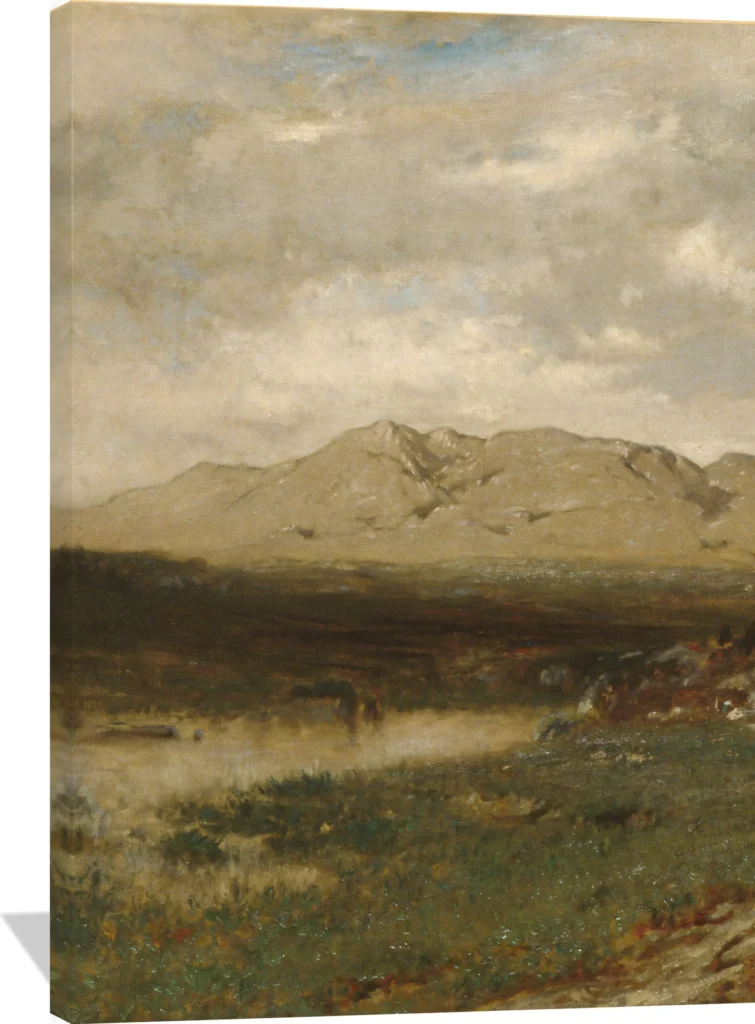
The Alexander H. Wyant View in County Kerry canvas captures the quiet majesty of Ireland’s rugged countryside. Soft earth tones of moss green, muted gold, and slate gray blend seamlessly under a luminous sky, evoking the serene solitude of open land and distant hills. A solitary cottage nestled near a reflective stream adds a touch of human warmth to the vast natural expanse.
This timeless wall art brings a sense of calm and depth to any space. Ideal for a living room, study, or entryway, this canvas print invites reflection and appreciation for nature’s understated beauty, just as Wyant intended in his masterful 19th-century landscape.
Alexander H. Wyant (1836–1892) was a leading American landscape painter whose work bridged the late Hudson River School and the emerging Tonalist movement. Revered for his atmospheric sensitivity and poetic handling of light, Wyant created intimate, contemplative scenes that conveyed nature’s quiet emotional power.
Artistic Style
Wyant’s mature style is marked by soft tonal harmonies, fluid brushwork, and a restrained, meditative mood. Moving away from the grand, panoramic landscapes favored by earlier Hudson River painters, he embraced a more introspective approach, using subtle gradations of color and shadow to evoke shifting weather, mist, and twilight. His work became a cornerstone of early American Tonalism, valued for its lyrical serenity and understated depth.
Subjects and Themes
Wyant often painted secluded streams, wooded valleys, and pastoral meadows, finding inspiration in the Catskills, Adirondacks, and the American Midwest. Rather than focusing on topographical detail, he emphasized atmosphere and emotion, allowing each scene to unfold as an intimate meditation on nature. His compositions frequently center on still water, distant hills, and delicate interplay between sky and land, capturing ephemeral moments with remarkable sensitivity.
Artistic Legacy
Despite facing physical challenges later in life, Wyant continued to paint with a refined, expressive touch that influenced a generation of landscape artists. His work helped usher in a more introspective interpretation of the American landscape one rooted not in spectacle but in mood, reflection, and the quiet power of the natural world. Today, his paintings remain emblematic of the transition from the dramatic vistas of the Hudson River School to the nuanced, atmospheric language of Tonalism.
Trust & policies
- 🚚 Free tracked shipping to 45+ countries. Local import duties or taxes may apply in some destinations.
- 🎨 Made-to-order, printed close to your delivery location
- 🛡️ If damaged, defective, or misprinted: free replacement or refund
- 🌍 Printed in US/CA/EU/UK/AU based on delivery location
- 💎 Acid-free, fade-resistant canvas with solid wood stretcher bars
- 🖼️ Optional pine floating frames in white, black, or brown
- 🪝 Ready to hang — hardware pre-installed