
Bird Catching Fish Among Reeds
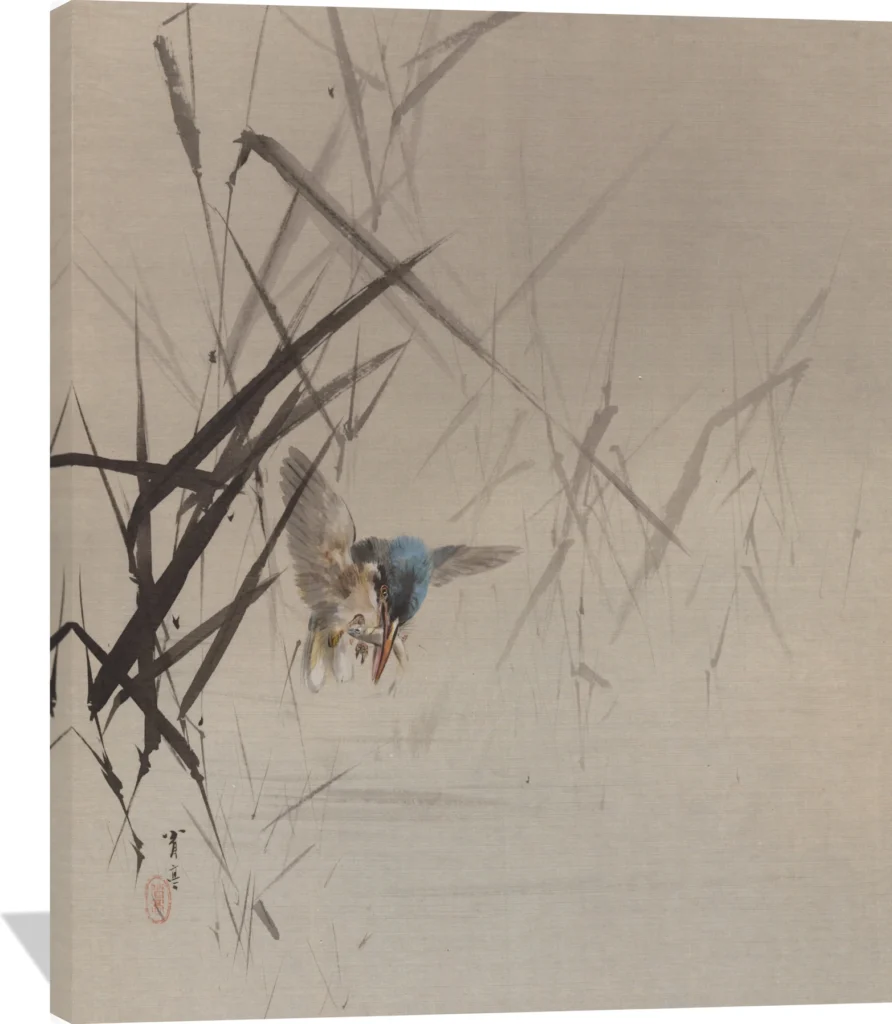
The Watanabe Seitei Bird Catching Fish Among Reeds canvas captures a fleeting moment of nature’s grace with exquisite Japanese refinement. A vivid kingfisher, rendered in soft blues and warm ochres, emerges from a tranquil field of misty reeds painted in delicate gray and taupe tones. Seitei’s masterful balance of motion and stillness evokes serenity and precision in every brushstroke.
This elegant wall art brings a sense of calm sophistication to any space—perfect for a living room, study, or entryway. The Bird Catching Fish Among Reeds canvas print celebrates the harmony of nature and artistry, inviting quiet contemplation and timeless beauty into your home.
Watanabe Seitei (Japanese, 1851–1918) was a pivotal figure in the evolution of modern Japanese painting, celebrated for his elegant fusion of traditional aesthetics with a refined naturalism that resonated both in Japan and abroad.
Artistic Style and Approach
Seitei is best known for his luminous kachōga, or bird-and-flower paintings, which combine meticulous observation with atmospheric delicacy. His works balance classical Japanese techniques with subtle Western influences, resulting in compositions that feel both timeless and fresh. This distinctive blend made him a leading voice in the Meiji-era effort to modernize Japanese art without sacrificing its poetic essence.
Subjects and Themes
Nature was Seitei’s enduring muse. He depicted birds, blossoms, foliage, and seasonal moments with exceptional sensitivity, often capturing fleeting gestures a wing in motion, a branch trembling with life. His illustrations and woodblock prints show a masterful command of line and color, revealing a deep reverence for the natural world.
Legacy and Significance
As one of the first Japanese painters to exhibit in Europe, Seitei introduced international audiences to a modern interpretation of Nihonga. His influence extended through his publications and designs, which helped define a new artistic vocabulary grounded in tradition yet open to global exchange. Today, his work is admired for its serenity, precision, and the subtle vitality that marks him as a key innovator of modern Japanese painting.
Trust & policies
- 🚚 Free tracked shipping to 45+ countries. Local import duties or taxes may apply in some destinations.
- 🎨 Made-to-order, printed close to your delivery location
- 🛡️ If damaged, defective, or misprinted: free replacement or refund
- 🌍 Printed in US/CA/EU/UK/AU based on delivery location
- 💎 Acid-free, fade-resistant canvas with solid wood stretcher bars
- 🖼️ Optional pine floating frames in white, black, or brown
- 🪝 Ready to hang — hardware pre-installed