
San Gimignano
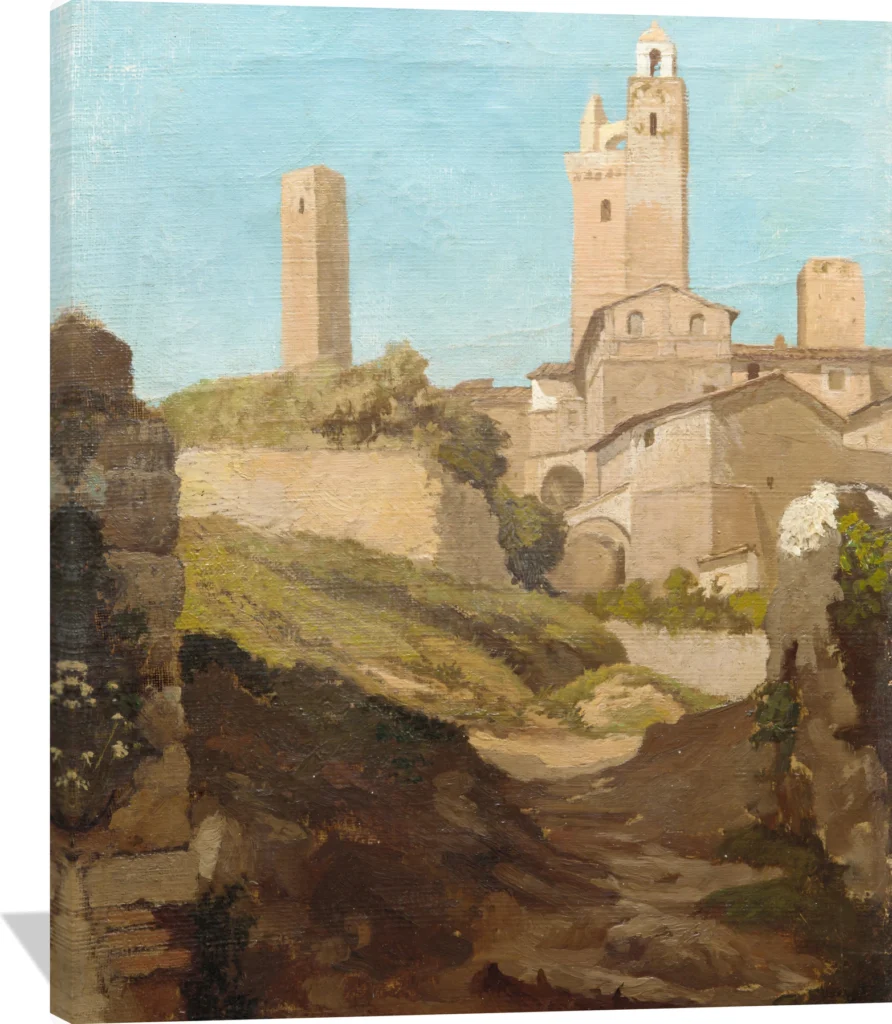
The Elihu Vedder San Gimignano canvas captures the timeless beauty of an Italian hill town bathed in warm sunlight. With its soft earth tones, golden stone walls, and clear blue sky, this evocative scene invites a sense of serenity and old-world charm. Vedder’s masterful brushwork and balanced composition lend depth and quiet grandeur to the medieval towers rising above the rustic landscape.
This elegant wall art brings a refined European atmosphere to any space—perfect for a living room, study, or entryway. A canvas print that celebrates history, light, and the poetic spirit of travel.
Elihu Vedder (American, New York 1836–1923 Rome) was a visionary painter and illustrator whose career bridged the intellectual curiosity of the American Renaissance with the poetic mysticism of European Symbolism. His lifelong connection to Rome deeply shaped the atmospheric quality and narrative richness of his work.
Artistic Style and Vision
Vedder’s art is distinguished by its dreamlike imagery, delicate draftsmanship, and a contemplative approach to myth and allegory. Blending classical influences with an imaginative, almost otherworldly sensibility, he often explored themes of fate, mysticism, and the human psyche. His refined handling of tone and texture, paired with shadowy, evocative compositions, established him as a central figure in the emerging Symbolist movement in the United States.
Notable Contributions
Vedder achieved lasting recognition for his illustrations to Edward FitzGerald’s translation of the Rubáiyát of Omar Khayyám, a body of work celebrated for its poetic unity and visionary intensity. These images helped cement his reputation as a master of evocative, philosophical art and broadened Symbolism’s reach within American cultural circles. His role in shaping book illustration and the era’s revival of allegorical subjects remains culturally influential.
Subjects and Themes
Typical subjects in Vedder’s work include mythological figures, personifications, and introspective scenes set against atmospheric landscapes. He gravitated toward images that suggested hidden meaning or emotional depth, inviting viewers to contemplate destiny, transience, and inner transformation. Whether painting solitary figures or elaborate narrative visions, Vedder infused his compositions with a quiet intensity that feels both timeless and deeply personal.
Legacy
Revered for his contribution to American art in the late nineteenth and early twentieth centuries, Vedder left a legacy defined by imagination, technical elegance, and symbolic resonance. His ability to merge classical beauty with introspective mystery continues to inspire collectors and admirers of visionary art. Through his paintings and illustrated works, he secured a place as one of the era’s most distinctive and enduring artistic voices.
Trust & policies
- 🚚 Free tracked shipping to 45+ countries. Local import duties or taxes may apply in some destinations.
- 🎨 Made-to-order, printed close to your delivery location
- 🛡️ If damaged, defective, or misprinted: free replacement or refund
- 🌍 Printed in US/CA/EU/UK/AU based on delivery location
- 💎 Acid-free, fade-resistant canvas with solid wood stretcher bars
- 🖼️ Optional pine floating frames in white, black, or brown
- 🪝 Ready to hang — hardware pre-installed