
Schloss Milkel in Moonlight
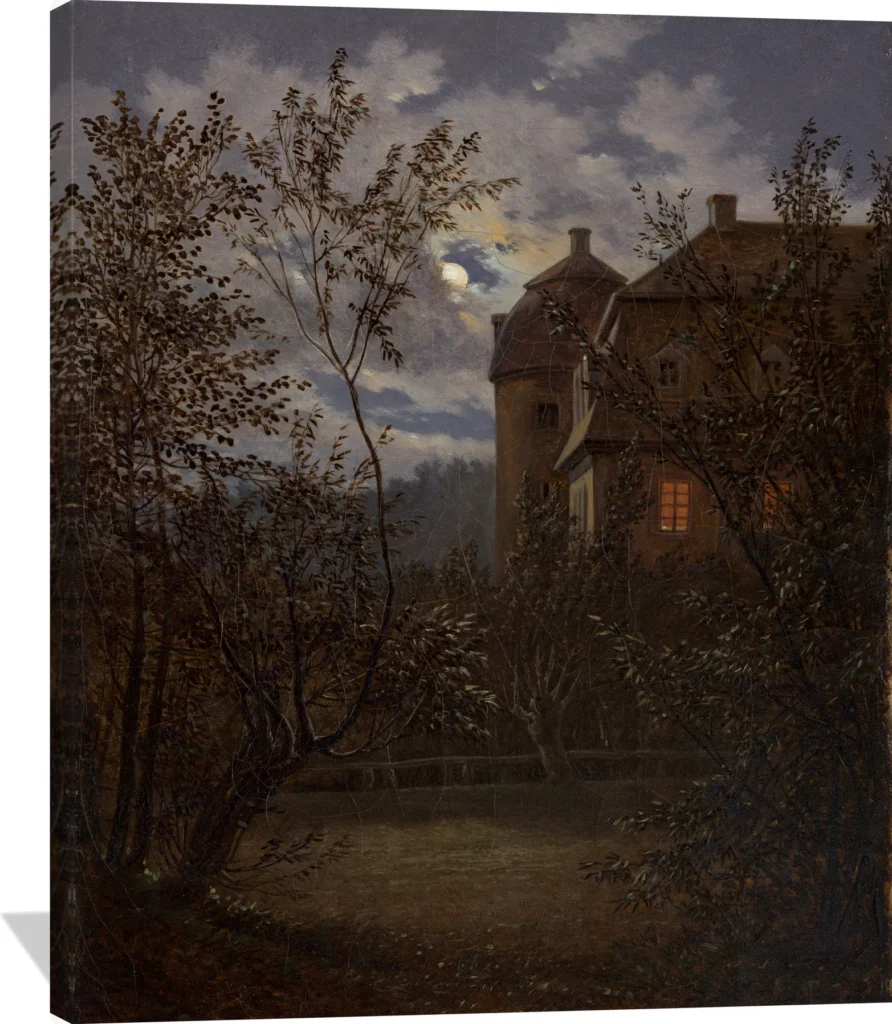
The Carl Gustav Carus Schloss Milkel in Moonlight canvas captures a tranquil nocturnal scene bathed in silvery moonlight. Subtle hues of deep brown, slate blue, and soft gray evoke a serene, Romantic atmosphere as the castle’s warm windows glow against the cool night sky. Carus’s masterful balance of light and shadow draws the viewer into a moment of quiet reflection.
This elegant wall art brings timeless sophistication to any living room, study, or entryway. A fine canvas print for those who appreciate the poetic stillness of nature and architecture under moonlit skies.
Carl Gustav Carus (1789–1869) was a German painter, thinker, and scientist whose work embodies the intellectual depth and poetic sensitivity of early nineteenth‑century Romanticism.
Artistic Style and Vision
Carus’s paintings are defined by a contemplative atmosphere, harmonious compositions, and a nuanced understanding of light. Strongly influenced by his friendship with Caspar David Friedrich, he embraced Romantic ideals that saw nature as a gateway to philosophical insight. His landscapes often balance precise observation with a quiet, meditative mood, revealing an artist who viewed the natural world as both scientifically fascinating and spiritually profound.
Notable Contributions
Alongside his medical and scientific pursuits, Carus became a leading figure in the development of Romantic landscape painting. He articulated the concept of “Earth-life painting,” a vision that merged geology, biology, and aesthetics to explore humankind’s relationship with the environment. His writings on art theory further shaped the discourse of the time, positioning him not only as a painter but as a cultural thinker whose ideas resonated across disciplines.
Subjects and Themes
Carus typically depicted sweeping vistas, mountain ranges, moonlit scenes, and architecturally framed horizons. These subjects reflect his fascination with natural processes and atmospheric effects. Works such as his celebrated moonrise and alpine landscapes exemplify his ability to blend scientific accuracy with emotional resonance, creating images that invite quiet reflection.
Cultural Significance
As a central figure of German Romanticism, Carus helped define a vision of nature that continues to influence art and environmental thought. His paintings offer a refined balance of inquiry and poetry, making him a compelling choice for collectors seeking works rooted in both artistic sensitivity and intellectual depth. His legacy endures through his dual identity as an artist and scientist, a combination that lends his art its distinctive sense of wonder and its enduring power to inspire.
Trust & policies
- 🚚 Free tracked shipping to 45+ countries. Local import duties or taxes may apply in some destinations.
- 🎨 Made-to-order, printed close to your delivery location
- 🛡️ If damaged, defective, or misprinted: free replacement or refund
- 🌍 Printed in US/CA/EU/UK/AU based on delivery location
- 💎 Acid-free, fade-resistant canvas with solid wood stretcher bars
- 🖼️ Optional pine floating frames in white, black, or brown
- 🪝 Ready to hang — hardware pre-installed