
Campo Santa Maria Zobenigo, Venice
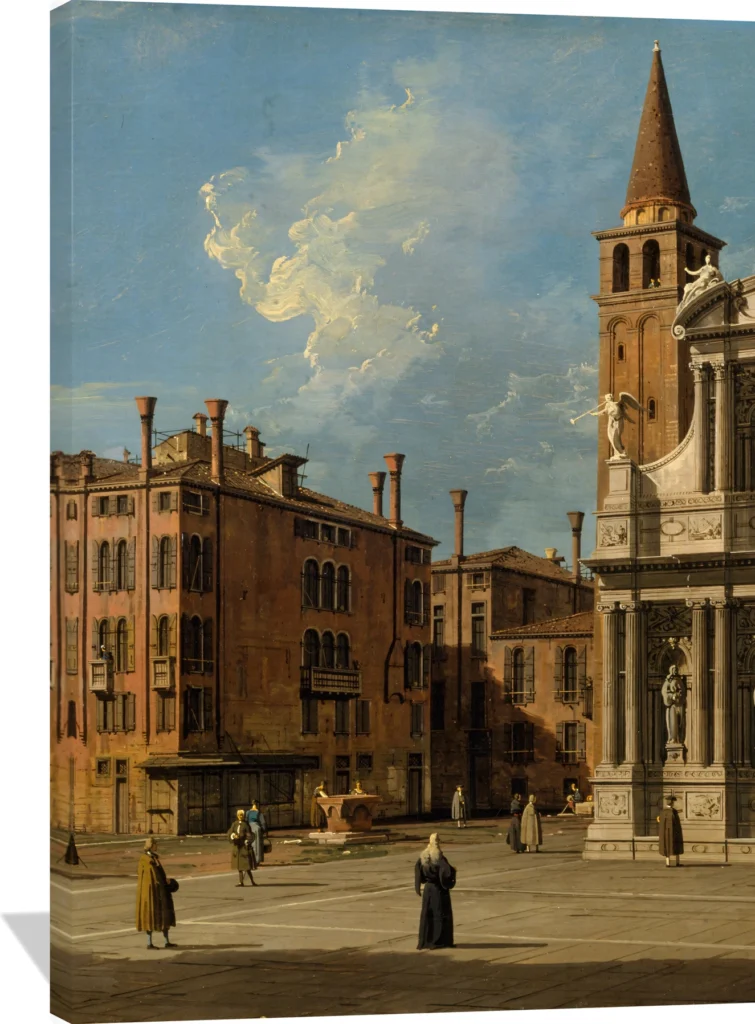
The Canaletto Campo Santa Maria Zobenigo, Venice canvas captures the luminous grandeur of 18th-century Venice with remarkable precision. Bathed in warm ochres, soft creams, and tranquil blues, this masterful cityscape reveals the ornate façade of Santa Maria Zobenigo under a clear Venetian sky, alive with figures and quiet daily life. Canaletto’s refined perspective and crisp architectural detail evoke timeless elegance and serenity.
This exquisite canvas print brings Old World sophistication to any interior. Ideal for a living room, study, or entryway, it adds depth, light, and a touch of historic charm to contemporary spaces. A true celebration of Venice’s enduring beauty and Canaletto’s unmatched artistry.
Giovanni Antonio Canal, known as Canaletto, was an Italian painter born in Venice in 1697 and celebrated for his luminous cityscapes that captured the splendor of his native city. Active through the mid‑18th century, he became one of the most sought‑after view painters of the Venetian Republic, admired across Europe for his clarity of vision and refined precision.
Artistic Style
Canaletto’s style is defined by crystalline detail, exacting linear perspective, and a distinctive ability to render atmosphere with remarkable naturalism. His mastery of light and shadow, combined with carefully structured compositions, gave his views a sense of grandeur and serenity. While he occasionally used a camera obscura to aid accuracy, his paintings retain a poetic clarity that elevates them far beyond mechanical representation.
Typical Subjects
He is best known for sweeping views of Venice: sunlit canals, bustling piazzas, monumental churches, and the shimmering surfaces of the lagoon. Works such as The Grand Canal from the Palazzo Flangini to San Marcuola and Piazza San Marco demonstrate his ability to depict both architectural majesty and everyday Venetian life. Canaletto also produced views of London during his time in England, bringing the same luminous precision to the Thames and the city’s rapidly evolving skyline.
Notable Contributions
Canaletto played a central role in shaping the genre of the veduta, or view painting, elevating it to new levels of sophistication. His paintings became highly prized among European travelers, especially the British aristocracy undertaking the Grand Tour, who sought his meticulously crafted scenes as visual souvenirs. Through his work, he created a lasting visual archive of 18th‑century Venice, preserving the city’s architecture and atmosphere with extraordinary fidelity.
Cultural Significance
Today, Canaletto is recognized as one of the great chroniclers of urban life in the early modern era. His views of Venice hold enduring cultural value, offering glimpses of a city at the height of its elegance and vitality. His influence can be traced in later landscape and cityscape traditions, where his balance of accuracy and artistry remains a benchmark. Collectors continue to value his work for its tranquil beauty and its ability to evoke the timeless charm of Venice.
Through his refined technique and visionary approach to depicting place, Canaletto secured a lasting legacy as a master of Venetian vedute and one of the most important topographical painters of the 18th century.
Trust & policies
- 🚚 Free tracked shipping to 45+ countries. Local import duties or taxes may apply in some destinations.
- 🎨 Made-to-order, printed close to your delivery location
- 🛡️ If damaged, defective, or misprinted: free replacement or refund
- 🌍 Printed in US/CA/EU/UK/AU based on delivery location
- 💎 Acid-free, fade-resistant canvas with solid wood stretcher bars
- 🖼️ Optional pine floating frames in white, black, or brown
- 🪝 Ready to hang — hardware pre-installed