
Wandering Minstrels
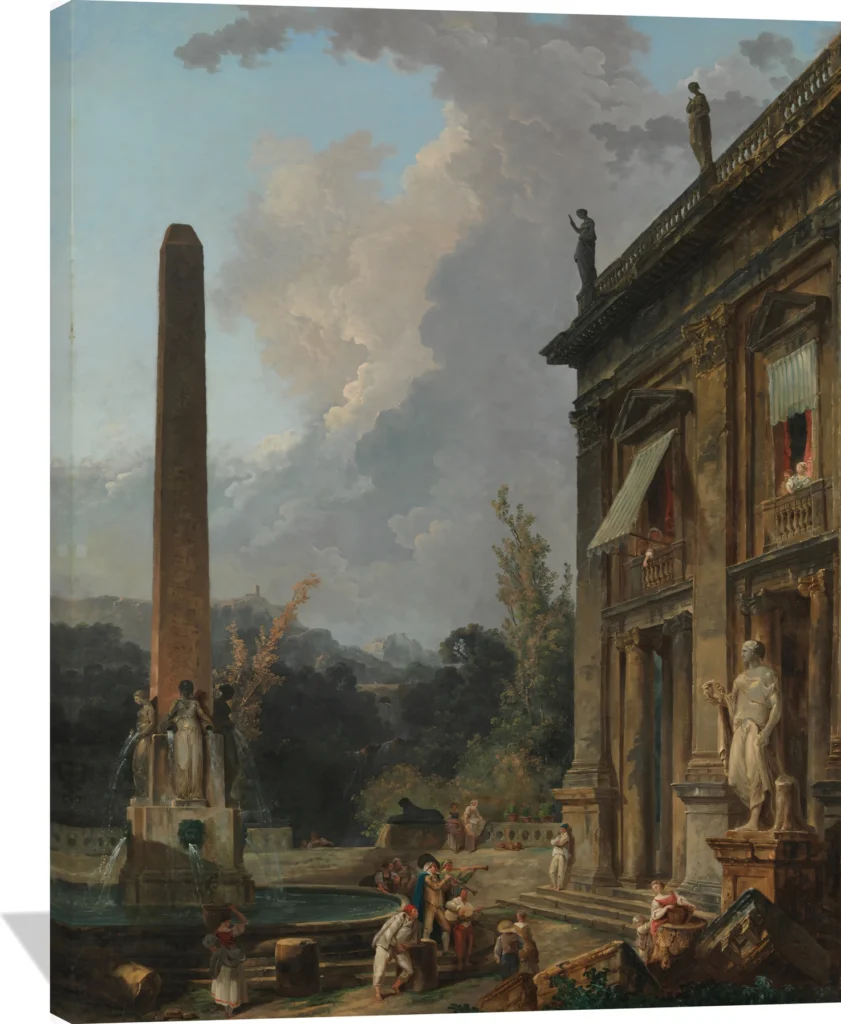
The Hubert Robert Wandering Minstrels canvas captures a luminous scene of classical grandeur and everyday life. Set against a sweeping sky of soft blues and silvery grays, the composition blends architectural majesty with the warmth of human presence. Golden stone facades, verdant greens, and gentle earth tones create a harmonious palette that radiates timeless elegance.
This exquisite wall art evokes the romance of 18th‑century Europe, where art, music, and nature converge in perfect balance. Ideal as a refined centerpiece for a living room, study, or entryway, this canvas print brings a touch of cultured serenity and historic charm to any space.
Hubert Robert (1733–1808), born and based in Paris, was a visionary French painter celebrated for his evocative landscapes and architectural fantasies. Trained in Rome, he absorbed the grandeur of classical ruins and transformed these impressions into poetic compositions that bridged reality and imagination.
Artistic Style and Themes
Robert’s work blends atmospheric landscape painting with the elegance of eighteenth‑century classicism. His signature style pairs delicately rendered figures with monumental structures, creating immersive scenes that highlight the passage of time. Known as “Robert of the Ruins,” he often presented ancient architecture in states of romantic decay, using light and shadow to heighten drama and emotional resonance.
Notable Contributions
As a leading figure of the French Enlightenment era, Robert produced designs for gardens, interiors, and royal commissions, influencing the aesthetic of some of France’s most prominent cultural spaces. His imaginative compositions, which sometimes placed contemporary Parisian landmarks in hypothetical ruin, offered a compelling fusion of historical reflection and artistic invention. His ability to reimagine real sites through a poetic lens remains one of his most distinctive contributions.
Cultural Significance
Robert’s paintings capture the eighteenth century’s fascination with antiquity, exploration, and the sublime. His refined sensibility and visionary approach positioned him at the heart of French artistic innovation, and his works continue to be admired for their balance of technical precision and dreamlike atmosphere. His legacy endures as a master of romanticized architectural landscape, whose images of ruins are as contemplative as they are grand.
Trust & policies
- 🚚 Free tracked shipping to 45+ countries. Local import duties or taxes may apply in some destinations.
- 🎨 Made-to-order, printed close to your delivery location
- 🛡️ If damaged, defective, or misprinted: free replacement or refund
- 🌍 Printed in US/CA/EU/UK/AU based on delivery location
- 💎 Acid-free, fade-resistant canvas with solid wood stretcher bars
- 🖼️ Optional pine floating frames in white, black, or brown
- 🪝 Ready to hang — hardware pre-installed