
The Honorable Henry Fane (1739–1802) with Inigo Jones and Charles Blair
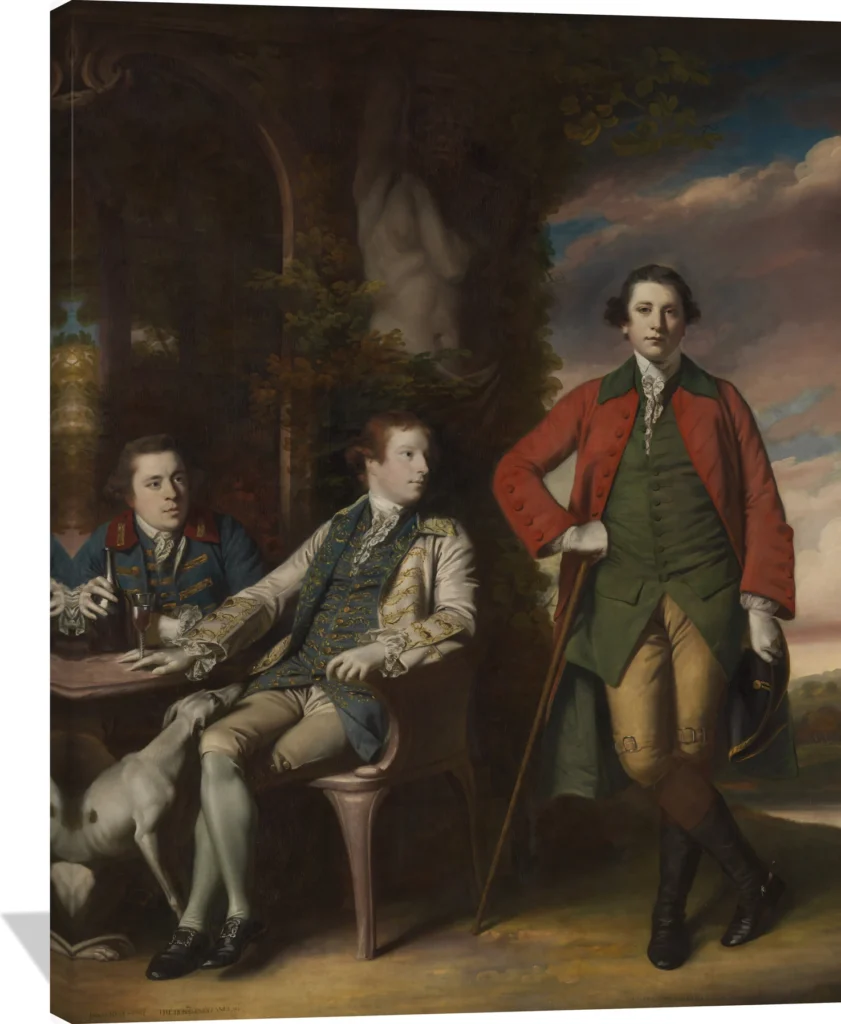
The Sir Joshua Reynolds The Honorable Henry Fane (1739–1802) with Inigo Jones and Charles Blair canvas captures the grace and grandeur of 18th-century British portraiture. Set against a luminous sky of soft blues and rose tones, three elegantly dressed gentlemen stand amidst a serene landscape, their refined poses framed by lush greenery and warm autumn hues. Reynolds’ masterful use of light and texture conveys both dignity and intimacy.
This timeless wall art brings a touch of aristocratic charm to any space. Ideal for a sophisticated living room, study, or entryway, this canvas print invites conversation and admiration through its balance of poise, color, and classic style.
Sir Joshua Reynolds, born in Plympton in 1723 and active in London until his death in 1792, stands as one of the most influential figures in British art. As the founding president of the Royal Academy, he helped shape the nation’s artistic identity and championed a vision of painting grounded in classical ideals and intellectual depth.
Artistic Style and Approach
Reynolds is best known for his elegant portraiture, characterized by composed grandeur, rich color harmonies, and a subtle interplay of light that lends his sitters an air of cultivated distinction. His technique blended Old Master influences with innovative methods, resulting in works that balance expressive character with formal refinement. His commitment to the “Grand Manner” established a standard for portraiture that emphasized dignity, poise, and moral presence.
Subjects and Themes
His subjects ranged from aristocrats and political leaders to writers, actors, and intellectuals, capturing the cultural landscape of eighteenth‑century Britain. Reynolds excelled at conveying psychological nuance, allowing viewers to sense both the public stature and private humanity of the individuals he painted. In works such as Lady Sarah Bunbury Sacrificing to the Graces and Portrait of Samuel Johnson, he united narrative elegance with acute observation.
Legacy and Significance
Reynolds’s impact extends beyond individual canvases. Through his celebrated Discourses on Art and his leadership at the Royal Academy, he helped define artistic education in Britain and encouraged painters to pursue historical, moral, and poetic subjects. His studio practices, experimental methods, and ambition to elevate portraiture to a higher intellectual plane left a lasting imprint on generations of artists.
Today, Reynolds is regarded as a foundational figure in British painting, admired for his sophisticated technique, expressive depth, and influential role in shaping the visual culture of his era. His works remain enduring examples of portraiture’s power to embody character, status, and the spirit of an age.
Trust & policies
- 🚚 Free tracked shipping to 45+ countries. Local import duties or taxes may apply in some destinations.
- 🎨 Made-to-order, printed close to your delivery location
- 🛡️ If damaged, defective, or misprinted: free replacement or refund
- 🌍 Printed in US/CA/EU/UK/AU based on delivery location
- 💎 Acid-free, fade-resistant canvas with solid wood stretcher bars
- 🖼️ Optional pine floating frames in white, black, or brown
- 🪝 Ready to hang — hardware pre-installed